



Displaced Services, Displaced People: Human Rights and the Malicious Governance of a De Facto Administration in Somaliland
The self-declared Republic of Somaliland, despite its claims of democratic governance and relative stability in the Horn of Africa, remains an unrecognized de facto administration whose legitimacy is contested and whose practices toward Certain communities raise grave human rights concerns. Nowhere are these concerns more starkly illustrated than in the recent actions taken against the Issa community in the Tokhshi and Ceel Gaal localities. The confiscation of a Quranic school and a health center by militia units, the subsequent jailing of elders who protested, and the systematic denial of social services represent not isolated incidents but a continuation of decades-long policies of marginalization, neglect, and what some observers describe as a slow-motion forced displacement. This essay argues that such actions violate fundamental human rights, expose the hollowness of the administration’s claims to good governance, and demand urgent international scrutiny.
A De Facto Administration Without Accountability
Somaliland’s lack of international recognition is often portrayed as a injustice by its supporters, but that same unrecognized status has a darker corollary: impunity. Without formal international legal personality, the administration in Hargeisa faces few external checks on its treatment of some communities. Its institutions—courts, security forces, and local administrations—operate without meaningful oversight. The governor in Saila is actively part and parcel of the problem. The result is a governance structure that, in practice, functions as a tribal-based authority, distributing resources and services along clan lines while punishing those who fall outside the dominant network. The Issa community, a distinct clan family with historical ties to the Zaila and Lughaya districts, has borne the brunt of this exclusion.
For more than three decades, the Issa have reportedly received little or no government contribution to health services, education, veterinary care, or water provision. Instead, they have built and maintained their own schools, clinics, and water points through community effort. The Quranic school of Tokhshi and the Ceel Gaal health center are emblematic of this self-reliance: both were constructed, equipped, and staffed by the Issa community. They were not government projects; they were community lifelines. The decision by militia units with the Sails governorate to seize these facilities for accommodation—displacing students, patients, teachers and medical staff—therefore represents not merely a misallocation of resources but a direct assault on the community’s most basic coping mechanisms.
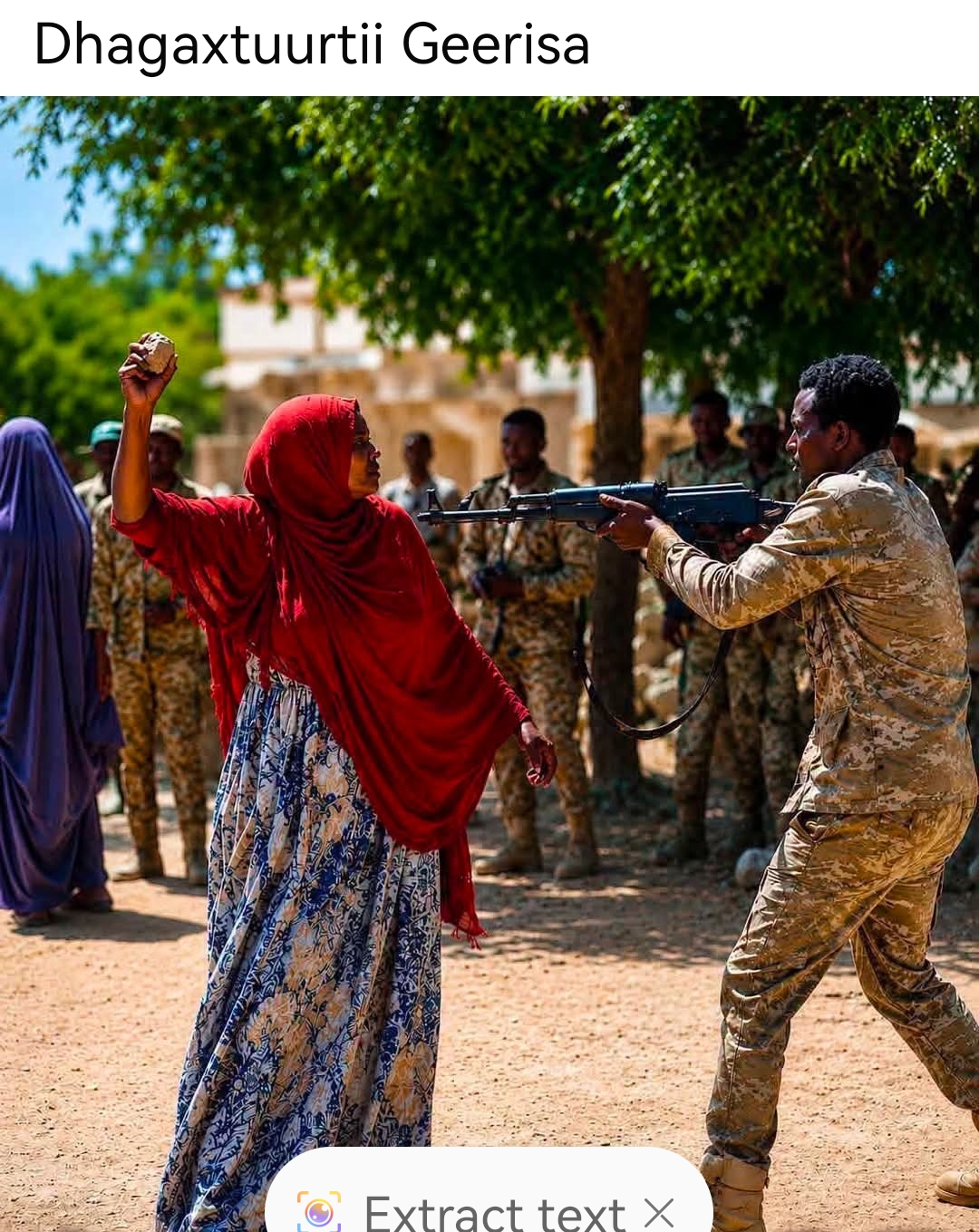
Human Rights Violations at Tokhshi, Ceel Gaal, Geerisa and others like Gargaara Bari and Indhabiraale
The reported events of July 2026, in which the Tokhshi Quranic school and the Ceel Gaal health center were occupied by regime militia, constitute furthering previously multiple and overlapping violations of international human rights law abuses in Lughaya, Geerisa, Gargaara Bari and Indhabiraale where denial of water, killings and detention for ransom, group raping and indiscriminate killings took place respectively. The celebration of the UNESCO recognition and registration of Xeer Issa as a tangible heritage of humanity was arbitrarily cancelled. Under the International Covenant on Economic, Social and Cultural Rights (ICESCR), which Somaliland’s administration has not been able to ratifiy but which reflects customary norms, everyone has the right to education (Article 13) and the right to the highest attainable standard of health (Article 12). The seizure of a school denies children access to education, a harm that is both immediate and intergenerational. The occupation of a health center denies essential medical care to an entire community, with potentially fatal consequences for pregnant women, children, and the chronically ill. These are not abstract rights; they are the conditions of survival.
Furthermore, the jailing of elders “for simply speaking out” violates the right to freedom of expression and peaceful assembly (ICCPR Articles 19 and 21). It also constitutes arbitrary detention, prohibited under Article 9 of the ICCPR. That the detained individuals were community elders—traditional leaders whose role is to mediate and represent—makes the action particularly egregious. It sends a clear message: dissent will be punished, and the community’s legitimate representatives will be silenced.
Beyond these specific violations, the pattern of conduct raises broader concerns under the International Convention on the Elimination of All Forms of Racial Discrimination (ICERD) and the African Charter on Human and Peoples’ Rights. The systematic denial of services, the lack of representation in Hargeisa for the Issa districts of Zaila and Lughaya, and the deliberate confiscation of community assets point to a policy of discrimination on the basis of clan identity. The African Charter, which Somaliland’s authorities often invoke rhetorically, guarantees the right to non-discrimination (Article 2), the right to education (Article 17), and the right to health (Article 16). The events at Tokhshi and Ceel Gaal are incompatible with these commitments….
A Policy of Marginalization and Forced Displacement
The Issa community’s experience is not new. The essay’s framing of a “perpetual and intentional” marginalization stretching back over a century reflects a historical grievance that cannot be dismissed. From the colonial era through the post-independence period and into the current de facto administration, the Issa have been treated as outsiders in their own land. The absence of Issa representation in Hargeisa is not an oversight; it is a structural feature of a governance model that reserves power for the dominant clan groups. The refusal to provide even minimal services—health, education, veterinary care, water—while simultaneously seizing the community’s own self-built facilities constitutes a form of collective punishment.
This pattern invites comparison with forced displacement and ethnic cleansing, though such terms must be used carefully. The Rome Statute defines ethnic cleansing as the deliberate removal of a population from a territory through violence, intimidation, or other coercive means. The systematic denial of services, the jailing of elders, the confiscation of community assets, and the absence of political representation are coercive measures that make life unsustainable. When a government refuses to provide the most basic conditions of life and then destroys the community’s own alternatives, it creates an environment in which departure becomes the only option. Whether one labels this “cleansing,” “forced immigration,” or “a Palestine-like displacement,” the human rights implications are the same: a population is being pushed off its land through deliberate state neglect, dismantlement of peace and hostility.
The reference to genocide is more contentious and requires rigorous evidence. However, the systematic destruction of a group’s social infrastructure—schools, health centers, places of learning and care—can, in certain contexts, constitute acts aimed at undermining the group’s existence. The UN Genocide Convention prohibits “deliberately inflicting on the group conditions of life calculated to bring about its physical destruction in whole or in part.” The cumulative effect of denying health care, education, and water, while confiscating the community’s own facilities, is to inflict precisely such conditions. Even if the label “genocide” is contested, the underlying acts demand investigation by international human rights bodies.
The Failure of the International Community
The international community’s silence on these abuses is itself a contributing factor. Because Somaliland is unrecognized, many governments and NGOs treat its internal affairs as beyond their mandate. Yet human rights do not depend on recognition. The UN Human Rights Council, the African Commission on Human and Peoples’ Rights, and international humanitarian organizations have a responsibility to monitor and report on abuses regardless of an entity’s legal status. The elders jailed in Tokhshi and Ceel Gaal are prisoners of conscience. The children denied their Quranic education and the patients denied health care are victims of a policy that the world has chosen not to see.
The Hargeisa administration’s actions also undermine its own claims to legitimacy. A government that seizes schools and clinics for militia barracks, that jails elders for speaking out, and that leaves entire districts without representation cannot credibly present itself as a model of African democracy. The “stability” that Somaliland often touts is a stability built on exclusion and coercion. True stability requires inclusive governance, respect for for all communities and minority rights, and accountability for abuses. None of these are present in the Issa districts of Zaila and Lughaya.
Conclusion and Recommendations
The confiscation of the Tokhshi Quranic school and the Ceel Gaal health center, the jailing of elders, and the decades-long denial of services to the Issa community constitute serious human rights violations that demand immediate attention. The de facto administration in Hargeisa, lacking international recognition and internal accountability, has shown itself willing to use militia units to suppress an already marginalized community and to destroy the community’s own institutions of survival. This is not governance; it is abuse dressed in the language of statehood.
The international community—governments, human rights institutions, and NGOs—must break its silence. Specific recommendations include:
1. Independent investigation: The UN Human Rights Council and the African Commission should establish a fact-finding mission to investigate the events in Tokhshi and Ceel Gaal, including the occupation of schools and health centers and the detention of elders.
2. Release of detainees: All elders jailed for peaceful protest must be released immediately and unconditionally.
3. Restoration of services: The militia must vacate the school and health center, and the facilities must be returned to community control.
4. Inclusive governance: Any future political arrangement in Somaliland must guarantee representation for the Issa community and equitable access to social services.
5. Accountability: Those responsible for ordering or carrying out these abuses must be held accountable, including through targeted sanctions if necessary.
The Issa community has demonstrated remarkable resilience, building and running schools, clinics, and water systems with no government support. That self-reliance should be supported, not punished. The world must recognize that the abuses in Tokhshi and Ceel Gaal are not isolated incidents but symptoms of a deeper malady: a de facto tribal administration that has chosen marginalization over inclusion, coercion over consent, and impunity over accountability. Until that changes, the human rights of the Issa people—and of all minorities in Somaliland—will remain at risk.