
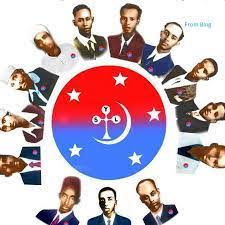
Pan-Somali Nationalist movement, Petitions to UNO.
Petitions are presented to the UN in New York in 1948. The moment is considered fascinating and pivotal in the history of the Horn of Africa.
The event referred to is the presentation of the Somali Youth League (SYL) petitions to the United Nations in 1948. This was a critical juncture in the pan-Somali nationalist movement.
1. The Real Purpose
The real purpose of the petition, from the perspective of the Somali petitioners, was genuine and clear: to reverse the colonial partition of the Somali-inhabited decided territories and create a single, independent Greater Somalia (Soomaaliweyn).
· The “Five Points” of the SYL Petition: The petition specifically demanded the unification of:
1. British Somaliland (the protectorate).
2. Italian Somaliland (the former colony, then under British military administration).
3. The Ogaden region including vast territory presently known as SITTI (administered by Ethiopia under British military oversight since 1941).
4. The Haud Reserve (another crucial Somali grazing area granted to Ethiopia by a 1954 treaty with Britain).
5. The Northern Frontier District (NFD) of Kenya.
The Issa délegation, integral part of the SYL délegation, successfully insisted to include French Somaliland as part of the Greater Somalia petitioned for unification. While SYL comprised of the majority of the Somali tribes, Italy succeeded to recruit elements or sympathisers from urban centers to lobby, in New York, to defend Italian candidature for the trusteeship responsibility of Italian Somaliland.
The request for Britain to be the trustee was a tactical compromise. The SYL and the majority of the Somali clans distrusted Italy (the former colonizer) and utterly rejected Ethiopian sovereignty over the Ogaden, Issa land, and Reserve area (Haud). They saw Britain as the most powerful local actor that could, under UN supervision, administer and prepare the entire Somali territory for a unified independence. Their ultimate goal was not permanent British rule, but unification as a stepping stone to full sovereignty.
2. How the Project Was Aborted in the Security Council
The project was aborted through a complex political process in the UN, not with a single vote on the petition itself, but through the negotiation of the future of Italy’s former colonies.
· The Context: The fate of all Italian colonies (Libya, Eritrea, and Italian Somaliland) was to be decided by the Four Powers (UK, US, France, USSR). They deadlocked repeatedly.
· The Bevin Plan: In 1946, British Foreign Secretary Ernest Bevin proposed a plan that aligned almost perfectly with the SYL petition: a single British-administered trusteeship over all Somali territories under under European protection and Ethiopian occupation , leading to independence. This is the “project”. It was this Bevin Plan that was ultimately defeated.
· The Abortion: The UN Security Council did not vote to “defeat the petition.” Instead, the petition was heard but ultimately ignored in the face of great power politics. The compromise that emerged was a huge disappointment to the Somali nationalists:
· Italian Somaliland was awarded to Italy as a UN Trusteeship (the Trust Territory of Italian Somaliland) for a 10-year period, after which it would gain independence.
· The Ogaden with Issa territory, Reserve area and Haud were returned to Ethiopian control, solidified by the 1954 Anglo-Ethiopian Agreement.
· British Somaliland remained a protectorate of G.B.
· The NFD remained part of Kenya.
This decision shattered the dream of a Greater Somalia and cemented the fragmented political landscape of the region.
3. Who Voted What to Defeat the Bevin Project?
It’s crucial to understand that the Bevin Plan was never formally put to a vote in the Security Council. It was discussed, negotiated, and ultimately abandoned due to vehement opposition, primarily from the Soviet Union and the unexpected lack of support from the United States.
The critical vote was on the future of Italian Somaliland. The UN General Assembly Resolution 289(IV) of November 1949, which approved Italy as the trustee for Somaliland, passed with a large majority. The voting was:
· In Favor (48 votes): Including the United States, United Kingdom, France, Italy, and most Western and Latin American countries.
· Against (7 votes): The Soviet Bloc (USSR, Byelorussian SSR, Ukrainian SSR, Czechoslovakia, Poland) plus Ethiopia and El Salvador.
· Abstentions (8 votes): Including Egypt, India, Pakistan, and others positioned neutral face of the two competing blocs.
The USSR voted against because it opposed any form of colonialism, including trusteeships, and saw it as Western imperialism. Ethiopia voted against because it wanted the area known as Ogaden which includes Issa remote areas but was fiercely opposed to a strong Italian (or any European) presence on its borders.
4. The Political Atmosphere Among the Colonial and Veto Powers
The atmosphere was one of Cold War tension and post-war realpolitik, which completely overrode the wishes of the Somali people.
· United States: Initially sympathetic to the Bevin Plan, the US changed its stance. It saw a rehabilitated, pro-Western Italy as a crucial ally in Europe against communism. Awarding Italy a trusteeship was a way to bolster its international standing and keep it in the NATO camp. The US also valued Ethiopia under Haile Selassie as a stable ally in Africa.
· Soviet Union: The USSR opposed all Western colonial projects on principle (cynically, as it was building its own empire in Eastern Europe). It advocated for immediate independence for all former Italian colonies and saw trusteeships as a form of continued imperialism. It was happy to exploit the issue to cause friction among the Western powers.
· United Kingdom: Britain was the plan’s proposer but found itself isolated. It was financially exhausted after WWII and could not afford to administer a vast new territory. It also faced immense pressure from its allies, the US and Italy, and from Ethiopia.
· France: France, a colonial power itself, was generally wary of any redrawing of colonial borders that might set a precedent for its own empire. It likely saw a large British-administered Somali state as a threat to its influence in Djibouti (French Somaliland).
· China: (Nationalist China held the seat then) Typically aligned with the Western powers on such issues.
5. Who Presented the Petitions? The Issa Tribe Delegation’s role.
The primary organization presenting the petitions was the Somali Youth League (SYL), the first modern Somali political party, which represented pan-Somali nationalism. The Issa delegates were an integral part of SYL but had specific concerns concerning the fate of Djibouti and Harar, which the Bevin Plan discarded.
Specific delegations were sent to the UN to lobby. A key figure was Abdullahi Issa, the SYL’s Secretary-General (and future first Prime Minister of Somalia), who led the delegation to New York.
The Issa clan specifically did indeed send a delegation. They were particularly concerned about the fate of the port of Djibouti (then French Somaliland) and their grazing lands. One of the most notable figures to address the UN Trusteeship Council was Haji Farah Ali Omar, an Issa representative. In a famous 1948 speech, he passionately argued for the inclusion of French Somaliland into the proposed Greater Somali state and eloquently pleaded the Somali case for self-determination, stating, “We are Somalis first and Muslims second… What we want is to be united and to be given our independence.”
In summary, the Somali petitions were a genuine expression of nationalist desire but were crushed by the emerging dynamics of the Cold War, where the strategic interests of the US (supporting Italy and Ethiopia) and the ideological opposition of the USSR outweighed the aspirations of a small, stateless nation.
—————————
Details to follow.