

Part lll:Tales of Travelers through the Horn of African Coasts; the Protectorate treaties.
The Somaliland Protectorate, established through a series of treaties signed between 1884 and 1886, represented distinct colonial clan entities whose engagements with the Issa Somali clan reveals the complex interplay between indigenous governance, customary law, and imperial administration. While the Issa were not the numerically dominant clan within the protectorate—that distinction belonging to the Isaaq—their strategic position along the Zeila district coast and their trans-border territorial reach made them indispensable interlocutors for British authority. The tales (récits) of 19th-century explorers, together with the administrative records of the protectorate, illuminate a people (Issa) whose Xeer-based legal order and Ogaasship transcended the very boundaries that colonial powers sought to impose.
Territorial Disposition: Between Protectorate and Colonial Frontiers
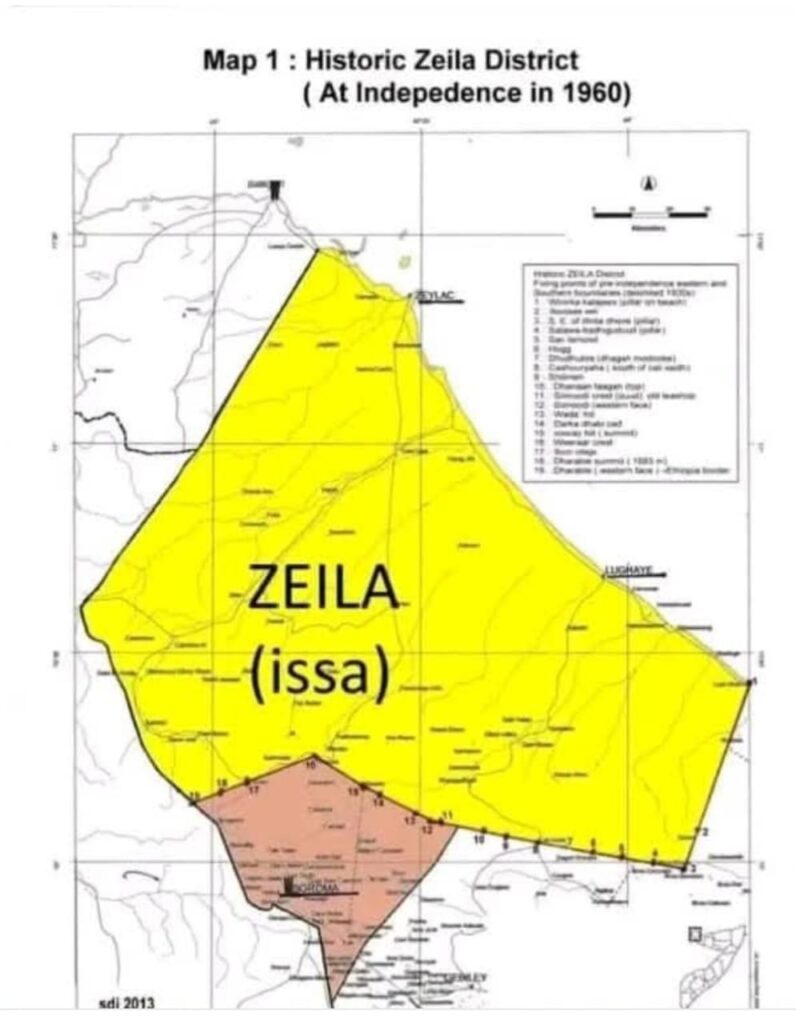
The territorial configuration of the Somaliland Protectorate was fundamentally shaped by treaties concluded with Somali clans in the mid-1880s. These engagements culminated in formal treaties signed between 1884 and 1886 with the Habar Awal, Gadabursi, Habar Toljaala, Habar Garhajis, Esa (Issa), and Warsangali clans. The protectorate’s boundaries, however, were never a straightforward reflection of clan territories. The Anglo-French agreement of February 2–9, 1888, delimited the boundary between British and French holdings on the Gulf of Aden, determining the alignment of the present Djibouti–Somalia boundary. This arbitrary line bisected Issa lands, severing families and grazing routes that had existed for centuries. The 1897 Anglo-Ethiopian Treaty further bisected these groups’ lands, establishing an unlawfull compromise between Ethiopian territorial ambitions and British efforts to honour their Somali treaties. Crucially, it guaranteed the right of British-protected Somalis to freely cross the border with their livestock to reach own mid-altitude pastures (the Haud and later Reserved Area) in Ethiopia. Yet both Britons and Ethiopians claimed the Gadabursi and ʿIse, leaving these clans in a precarious jurisdictional limbo.
Within the protectorate itself, the Issa fell under the administrative purview of the Zeila and Borama agencies. The two Somal tribes coming directly under this double agency were respectively, the the Issa and the Gadabursi, both of whom acquired “unenviable reputations” for treachery in colonial discourse. The British continued the Egyptian system of employing representatives of the various clans as agents or go-betweens, known as Akils. By the early 20th century, there were thirty-six Issa and thirty-seven Gadabursi Akils on the respective district books, providing some indication of the number of clans and families into which these tribes were divided. This administrative apparatus sought to render legible a pastoral society whose territorial logic operated according to the customary norms of Deegaan (permanent settlement) and Daaqsin (seasonal grazing range), systems that formed the basis of inter-clan coexistence and resource sharing. On both sides, close families were benefiting from the Daaqsin status.
The customary boundaries between the Issa and their Gadabursi neighbours were not ambiguous; they were clearly identified through generations of oral tradition and practice. Key components included the-weeraar- Aroorseel–Harirad–Ethiopia border corridor, marking the core inter-clan boundary, from Saila with approximately more than100 miles of Issa territory extending inward to Harirad. Areas such as Ali Haidh, Garba-Dadar, and Farda Lagu-Xidh toward Ceelahely- to the South of Almis mountain, (Geeri) straight to the Ilinta Dhexe were historically associated with Issa permanent settlements (deegaan), while Ceel Sheikh of Lughaya, El Gal-Asha Addo, and the coastal zone extending to Zeila and beyond to Goubet were recognized as Issa Deegaan. These boundaries were not mere abstractions; they were enforced through Xeer Issa and cross-community acknowledgment, and they remain central to contemporary disputes over territorial claims in the present Awdal and Salal regions.
Demography: The Issa in a Multi-Clan Protectorate
Demographic British estimates from the late 19th and early 20th centuries consistently positioned the Issa significant but minority population within the Somaliland Protectorate compared to Isaaq and Harti. In 1954-55 the population census indicate Issa 55000 and Gadaburi 45000 person’s. A British source from 1899 estimated the protectorate to have a population of two hundred and forty-six thousand, comprising the Esa, Gadabursi, Habr Awal, Habr Gerhajis, Habr Toljaala, Dulbahanta, and Warsangeli tribes. The last British population estimate on the basis of clan in Somaliland, conducted 1954-55 and proclaimed contested results in 1959, just before independence in1960, recorded that out of some 650,000 ethnic Somalis belonging to three major clans residing in the protectorate, the Isaaq, Darod and Dir (Issa and Gadabuursi) made up 66%, 19% and 16% of the population, respectively. The Issa, as a subclan of the Dir, constituted a portion of that 16%, alongside the Gadabursi, who were predominant clans of the old Zaila district hinterland of the protectorate, where a sizeable minority of the Somalis, Africans and Asians also inhabited the Metropolitan City of Zeila .
The Issa’s demographic presence was, however, significantly larger when considered across the broader regional landscape that colonial boundaries had artificially divided. The Issa are geographically spread across Djibouti, Ethiopia, and Somaliland protectorate, with their traditional authority, the Ugaas, seated at Jildessa, but later at Dire Dawa—a city that constitutes one of their principal urban centers of power. In Djibouti, itself, the Issa make up more than half of the population, while in Ethiopia’s Somali Region they are concentrated in the Sitti Zone and Dire Dawa City. This trans-border demographic reality meant that British administrative estimates of the Issa within the protectorate captured only a fraction of a people whose social and political organization recognized no colonial frontiers. The Issa were, in effect, a people of three states, collectively bound by a shared Xeer and a single Ogaasship that refused to acknowledge the legitimacy of the lines drawn at Berlin.
Xeer Ciisa and Ogaasship: The Architecture of Issa Governance
At the heart of Issa social and political organization lay the Xeer, a body of oral customary law that functioned as a comprehensive constitutional framework. Unlike Western legal concepts, Xeer Issa was an all-encompassing system that dictated the sharing of essential resources—land, pasture and water—defined governance through the authority of the Ogaas, and codified conflict resolution, collective responsibility, and social harmony. It was not merely “customary law” in the conventional sense; it was the cornerstone of Issa sovereignty, a binding agreement that every member was born into and obligated to uphold. UNESCO’s inscription of Xeer Ciise on the Representative List of the Intangible Cultural Heritage of Humanity in 2024 recognized it as a “highly structured and rigorously codified system of democratic governance” with three main components: a political constitution defining the distribution of power and decision-making processes; a penal code establishing community justice focused on reconciliation and compensation; and a code of social conduct regulating collective and individual behaviour.
The Xeer’s governance architecture was remarkably sophisticated. The Ugaas, or paramount chief, was not an autocrat but a leader directly accountable to the community, which could dismiss him for incompetence, lack of charisma, or even lack of magic power. Through the history of the Xeer, some Ugaases were dismissed for various reasons, including incitement to war, partiality, greed, and inability to call for or lacking the providential power to provoke rain fall. The act of impeachment was a ritual gesture consisting of removing the turban he wore on his head, a responsibility entrusted to a particular clan. Representatives in the assemblies—the Guddi and Gande—could be changed by their clans if considered incompetent or corrupt, and decision-making sessions were open to all males above fifteen years old, allowing communities to follow deliberations and control the achievements of their representatives.
The most celebrated historical embodiment of the Ogaasship was Ughaz Roble Farah, known to European explorers as the “Rain Prince.” Flourishing in the mid-to-late 19th century, he was the 14th Ughaz of the Issa Ughazate, establishing his courts at the strategic settlement of Jaldessa along vital caravan routes from Zeila to Harar. The Italian explorer Antonio Cecchi and the Egypto-Turkish expedition described him as an eloquent leader capable of instantly rallying up to 40,000 warriors, underscoring his military and oratorical prowess in an era of expanding Ethiopian and European influences. His epithet as the Rain Prince, recorded by Austrian traveler Philipp Paulitschke, evoked traditional Somali beliefs linking rulers to ranfall and fertility, symbolizing his role as spiritual custodian amid the clan’s nomadic pastoralism. The Ogaasship was not hereditary in the strict dynastic sense; in the Issa clan, the Reer Hassan a Wardiq sub-clan traditionally provided the Ughaz, a practice that reflected the Xeer’s integration of blood ties with rule-based governance.
The Xeer was not a static tradition but a living legal order open to change through judicial precedent. In their deliberations, the Guddis had to respect existing jurisprudence, first determining whether a case was a “known case” (Curad) requiring only the application of established law, or a new and unknown case (Ugub) requiring innovation and adaptation. A precept established this adaptability: “An unseen case requires an unheard verdict”. Knowledge of the Xeer was inculcated from an early age through tales, proverbs, games, poetry, and initiation rites, and from the age of fifteen every young man was encouraged to attend the deliberations of the Assemblies to train for his future role as an active member. This civic education may explain the strong awareness of, and commitment to, notions of legality and respect for the rule of law among the Issa community.
Tales of 19th-Century Explorers: Burton and the Isa
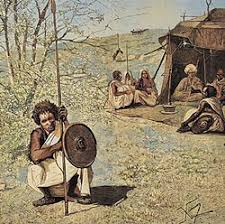
The European textual encounter with the Issa began in earnest with Sir Richard Francis Burton’s expedition of 1854–1855. Landing at Zeila, Burton stepped into a region that European maps still rendered as blank space. His mission, sponsored by the Royal Geographical Society, was to survey trade routes and assess the potential for British influence in the interior, but he also sought to understand the people of the Horn on their own terms. Disguised as Hajj Abdullah, a Muslim merchant from India, he set out with a small caravan inland toward the legendary city of Harar. The first to test him were the Isa (Ciise) clan, who controlled Zeila and the surrounding lowlands and were renowned for their fierce independence and mastery of the desert trails. They guarded the caravan routes with the vigilance of hawks, exacting tribute from traders who passed through their land. Burton’s disguise was immediately scrutinized, and Isa elders questioned him in Arabic, probing his knowledge of the Qur’an and his lineage. His responses, calm and fluent, impressed them enough to grant safe passage, though they made clear that his safety depended on their protection—and their payment.
In his journals, Burton described the Isa as “a nation of orators and horsemen, whose pride of race is their creed”. To him, they embodied the paradox of the Somali people—at once welcoming and wary, poetic yet practical, guided by a code of honor older than any written law. Burton’s characterization of ʿIse Somalis as a “fierce and turbulent race of republicans” connected hereditary characteristics to cultural aspects of the Somali “nation” in a manner typical of contemporary racial assumptions. Yet his account also revealed a society organized around principles of honor, hospitality, and contractual obligation that European legal categories struggled to accommodate.
Beyond Burton, a succession of explorers contributed to the European documentation of the Issa. The Encyclopædia Britannica recorded that Somaliland was one of the last parts of Africa to be explored by Europeans, with the occupation of Aden in 1839 proving the starting-point for the opening up of the country. Lieut. Cruttenden (1848), Burton, and Lieut. J. H. Speke were among the first explorers of the interior, officers of the Indian army quartered at Aden. In 1854 Burton, unaccompanied, penetrated inland as far as Harar, but later the expedition was attacked by Somali near Berbera, both Burton and Speke being wounded, and another officer, Lieut. Stroyan, R.N., killed. For twenty years afterwards no attempt was made to open up the country, until the occupation of Berbera by the Egyptians in 1875, was followed by several journeys into the interior.
French travelers also contributed to the exploration of the region. G. Révoil made three journeys in the north-east corner of the protectorate between 1878 and 1881, particularly in the Darror valley. Italian explorers, meanwhile, undertook the exploration of the hinterland after the greater part of the eastern seaboard had fallen under Italian influence. In 1890 Brichetti-Robecchi made a journey along the eastern coast from Obbia to beyond Cape Guardafui, and the following year he went from Mukdishu to Obbia, and thence crossed through Ogaden to Berbera on the Gulf of Aden. These journeys, while primarily motivated by scientific and strategic interests, produced a body of ethnographic and geographic knowledge that would inform colonial administration for decades to come.
Conclusion
The Somaliland Protectorate’s engagement with the Issa clan reveals the fundamental tension between colonial territorial logic and indigenous legal and political order. The protectorate’s boundaries, established through treaties with Somali clans and subsequently modified by agreements with France and Ethiopia, bisected Issa lands and subjected a trans-border people to the administrative fragmentation of three empires. Yet the Xeer Issa and the Ogaasship proved remarkably resilient, maintaining a unified legal and political framework that transcended the “de facto” lines of colonial cartography. The Issa endured this division not by accepting it, but by nurturing their unity in parallel to it, maintaining the Xeer as the supreme authority that transcended the alien rule of distant capitals. The tales of Burton and his successors, for all their racialized assumptions and strategic motivations, inadvertently documented this resilience—a people whose “pride of race” was inseparable from a legal order that recognized no sovereign but the community itself. In the end, the récits of voyageurs and the administrative records of the protectorate constitute a fragmented but revealing archive of a people whose Xeer-based sovereignty would outlast the empires that sought to contain it.