
Part Two: The Pillars as Policy: The Issa Plight and the Governance Practices of Breakaway Somaliland
Part One treated the four pillars of Imam Ali—justice, preservation of the system, consideration of the public interest, and respect for human dignity—as a diagnostic for the Somali condition as a whole. Part Two applies that diagnostic to a single, concentrated case: the Issa community of breakaway Somaliland. The purpose is not to repeat the anatomy of marginalisation but to examine it as policy and governance practice—to ask what the authorities in Hargeisa actually do, and fail to do, when measured against each pillar. The Issa case is analytically valuable precisely because Somaliland presents itself as an exception to Somali state failure, a democratic experiment in the Horn. It is not; that self-presentation is misleading. If the pillars collapse there, they collapse everywhere.
Pillar One: Justice as Practice—Elections, Counting, and the Refusal to Remedy
Imam Ali held that justice is the foundation of government and that any order not built upon it will eventually weaken and collapse. In governance practice, justice is not an abstraction; it is the integrity of the mechanisms by which power is allocated. Somaliland’s electoral administration in mixed-clan districts reveals a consistent pattern in which the state’s institutional machinery produces outcomes that the affected communities regard as fraudulent, and then refuses to provide a remedy.
The 2005 general elections were organised and conducted amid an administrative environment already stacked against the Issa—an environment described below—and the community protested against the tactical manoeuvres embedded in that process. Their protests received no attention. The Issa therefore boycotted that election but returned to the polls in 2012 to test the system again, hoping that participation might vindicate their rights. What they encountered was the worst.
In the 2012 local council elections in Seylac and Lughaya, Issa-backed candidates performed extraordinarily well. The voting itself was smooth, but the results were irresponsibly inverted: the Gadabuursi minority in both districts was declared to have won a majority of seats, and for the first time in history both mayorships of Zaila and Lughaya were awarded to them. The Issa cried foul, claiming that the counting was fraudulent and surrealistic, that the election was totally rigged, and presenting proof that approximately ninety per cent of ballots were found thrown away. Peaceful demonstrations erupted in Zaila and Lughaya. The security militia, composed solely of Isaaq and Gadabuursi, responded with indiscriminate fire and left heavy casualties. The dispute remains unresolved to this day—a standing demonstration that the deliberately manufactured competition for power among the clans will continue to pose a difficult challenge for any democratisation process in Somaliland.
This is not an isolated administrative error. It is a governance practice: when electoral outcomes in mixed districts favour the centre’s preferred clients, the count stands; when they favour the Issa, the count is negotiable, and the security forces enforce the negotiable outcome. The 2005 precedent taught the Issa that protest would be ignored. The 2012 precedent taught them that participation would be punished. The chronic problem always stands.
Pillar Two: Preservation of the System—Borama, Gerrymandering, and the Architecture of Exclusion
Ali’s second pillar is the preservation of the conditions under which a just order can endure. Somaliland’s defenders point to its hybrid system of clan power-sharing, forged at the 1993 Borama conference, as precisely such a condition—a consociational arrangement designed to give all clans a stake. In practice, however, the system was constructed in a manner that excluded the Issa from the outset and then preserved that exclusion through administrative manipulation.
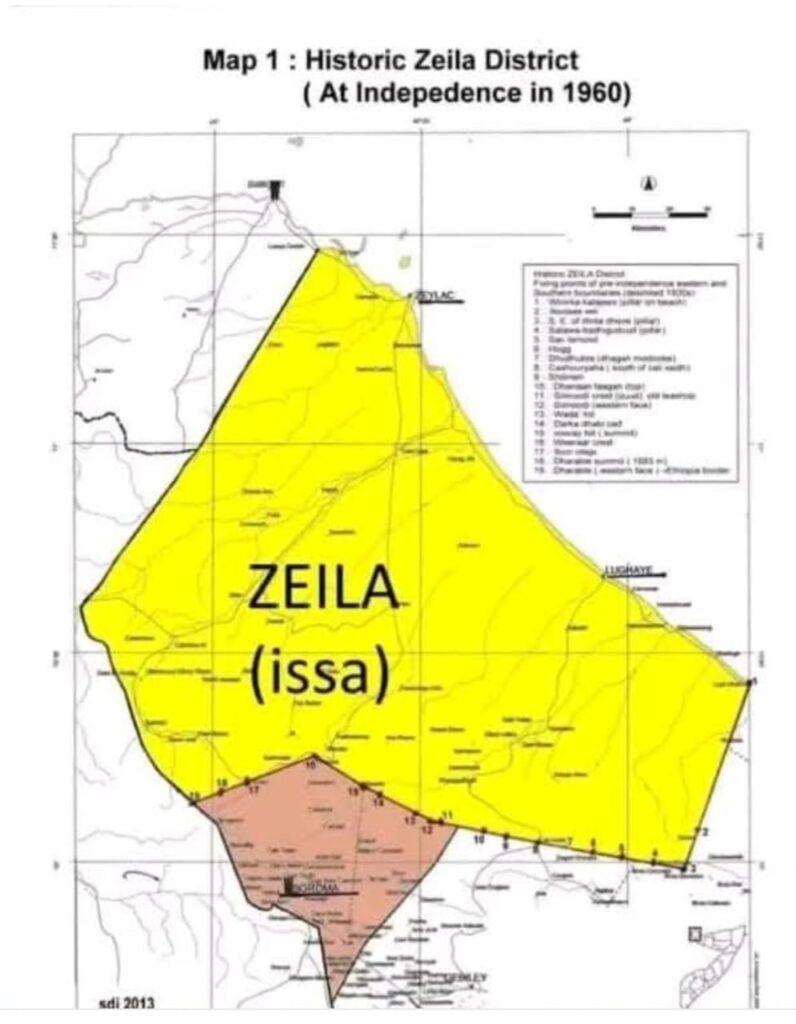
At Borama, Issa representation was quasi-nonexistent for security reasons. The conference was convened in a climate of hostility shaped by an Isaaq–Gadabuursi alliance against the Issa. This was not a neutral founding moment; it was a settlement among victors and their partners, from which the Issa were structurally absent. The consequences were encoded into the architecture of the new polity. The conference decided that the interim government would depart from the 1960 arrangement with respect to geographic territorial delimitations between tribes and the administrative set-up of districts. That decision opened the door to a sustained programme of administrative gerrymandering—a Rayale-style gerrymander in this case.
The administration that emerged from Borama then subverted the 1960 concept illegally. It dismembered the 1960 Zaila district to dilute or fragment Issa voting strength, transferred Lughaya’s administrative territory to Borama district as an act of tribal gerrymandering intended to win majority votes, and, for the same purpose, illegally combined the 1960 districts of Zaila and Borama into a single election district. It assigned or assured the administration of the so-called Awdal and Selel regions to exclusively Borama officials, including the security apparatus. The effect was to convert a neutral administrative map into a partisan instrument: the Issa’s demographic weight in Zaila and Lughaya was diluted by merging their historic districts with Borama, their land and administrative rights were reassigned to a rival clan’s district, and the security forces that would police subsequent elections were placed under the exclusive control of the very officials whose electoral prospects depended on suppressing the Issa vote.
This is the environment in which the 2005 elections were organised and conducted. The Issa protested against these tactical manoeuvres and boycotted but received no attention. They returned in 2012 to test the system again and encountered the worst. This chronic problem always stands because the architecture itself produces it.
The exclusion is not only administrative. Over time, Isaaq representation in the House of Representatives rose from 63 per cent in 1997 to 74 per cent in 2021, while non-Isaaq representation fell from 37 per cent to 26 per cent. In the 2021 parliamentary elections, Isaaq candidates won 57 seats, gaining ten seats at the expense of Harti and minority representation, and Isaaq representation overall increased to 61 seats, nearly three-quarters of the institution. Awdal-Selel leaders had demanded that half of the House seats be allocated to non-Isaaq clans—Samaroon, Issa, and Harti—precisely to protect minority rights against majoritarian capture. The demand was rejected, and the 2005 seat allocation was reimposed by law in 2020 despite strong opposition from Awdal MPs and elders. The system is preserved, but it is preserved as a hierarchy. When the Issa and other non-Isaaq communities seek institutional redress, they discover that the architecture of the system itself is the obstacle.
The broader pattern is not confined to the Issa. With the Harti having quit Somaliland to join the Federal Government as a state, the Issa holding no seat in Somaliland’s parliament, and the Gadabuursi still unconvinced, clan-driven state-building born of mismanagement and egoism rewards exclusion over inclusion. Unless governance is recentered on shared citizenship and accountable federalism, such Machiavellian bargaining will continue to erode Somaliland’s cohesion and stability.
Pillar Three: Public Interest—Resources, Development, and the Political Economy of Neglect
Imam Ali instructed his governors to protect the rights of the public and the poor and to distribute resources justly. In Awdal and Selel, particularly Issa-inhabited areas, the governance practice is the inverse: taxation without representation and contribution without return. Development funding consistently bypasses the region, leaving infrastructure projects and economic opportunities concentrated elsewhere, while residents face heavy taxation without meaningful representation in the bodies that determine expenditure. Strategic infrastructure has been repeatedly promised but never delivered; trade routes and development priorities bypass the region; and years of tax contributions flow to the centre without commensurate investment. Awdal-Selel is not unique in this respect—peripheral regions across Somaliland complain of the same pattern—but the Issa experience is sharpened by the resource dimension of the conflict. Clashes between Issa and Gadabuursi have repeatedly flared over access to local resources, influence in border trade, grazing zones, water points, and pasture in an arid environment where ecological scarcity is a daily fact of life.
When the state does not distribute resources justly, the clan becomes the distributor and the militia becomes the enforcement mechanism. The public interest is not merely neglected; it is redefined as the private interest of whichever lineage controls the seat. The Issa’s recourse to customary law and armed self-defence is a rational response to a state that has privatised the public treasury along clan lines and rigged the administrative map to ensure that the privatisation continues.
Pillar Four: Human Dignity—Coercion, Cultural Rights, and the Obliged War
The fourth pillar is the most severely wounded in Awdal-Selel. Ali upheld human dignity even in dealing with enemies. The governance practice of the Somaliland authorities, by contrast, has repeatedly treated the Issa’s cultural and political claims as security threats to be managed through force.
The December 2025 Xeer Ciise crisis is the exemplary case. Xeer Ciise, the oral customary law of the Somali-Issa communities, was inscribed on UNESCO’s Representative List of the Intangible Cultural Heritage of Humanity in December 2024. A cultural celebration was scheduled in Saylac for December 5, then postponed to 14 December 2025 by Hargeisa. The authorities first approved it and then cancelled it under pressure from Gadabuursi elders. The Issa viewed the cancellation as an assault on an entrenched cultural right. The paramount chief called for mass mobilisation and self-defence, accusing Hargeisa of partiality and of siding with the Gadabuursi; forces mobilised, and violence erupted alongside arson and looting. The minister of information resigned in protest. Subsequent clashes in Borama in December 2025 killed more than twenty and injured nearly fifty after security forces used live gunfire on demonstrators. A government that authorises a cultural commemoration and then cancels it under pressure from a rival clan, and then meets the resulting protest with lethal force, is not preserving dignity. It is administering humiliation.
The diagnostic term for what follows is the obliged war: a community—the Issa—that has been structurally marginalised for three decades, whose land, customs, and political voice have been treated as negotiable by a distant centre, reaches a point at which the defence of custom, grazing access, and symbolic recognition becomes indistinguishable from physical survival. The Issa did not choose tribalism and war as means or as an ideology. The de-facto state left no other ladder standing. When a customary legal code recognised by UNESCO must be defended with rifles because the institutions of the state will not mediate or hear the case, dignity has already been lost—and the state has already lost its moral claim on the community’s allegiance.
Conclusion: The Pillars as Policy Test
The four pillars are not a sectarian standard. They are the minimum conditions of legitimate governance anywhere. Applied as a policy test to breakaway Somaliland’s treatment of the Issa, the verdict is unambiguous. On justice: the 2005 elections were conducted in a rigged administrative environment and the Issa’s protests were ignored; the 2012 elections in Seylac and Lughaya were inverted, the community was fired upon, and the dispute remains unredressed. On preservation of the system: the 1993 Borama conference excluded the Issa quasi-entirely, was convened in hostility shaped by an Isaaq–Gadabuursi alliance, departed from the 1960 territorial and administrative arrangements, violated its own constitutive law, dismembered the 1960 Zaila district, transferred Lughaya to Borama, combined Zaila and Borama into a single election district, and placed Awdal and Selel under exclusive Borama officials including the security apparatus—while non-Isaaq representation in the House fell from 37 per cent to 26 per cent. On public interest: Awdal-Selel is taxed without representation, its development bypassed, its resources contested, and its public treasury treated as the prize of the centre. On human dignity: cultural rights recognised by UNESCO have been cancelled under clan pressure and defended with live ammunition.
The Issa are not a peripheral footnote to the Somali plight. They are its clearest empirical demonstration. A state that fails the four pillars in its most stable and most democratically advertised region cannot claim to be an exception to the regional crisis; it is its most sophisticated expression. Until the pillars are restored as governance practice—beginning with an independent audit of the 2005 and 2012 Seylac and Lughaya results, the restoration of the 1960 district boundaries and a separate election district for Zaila and Lughaya, a revised seat allocation that respects non-Isaaq representation, equitable development expenditure in Awdal-Selel, and the replacement of coercive containment with institutional remedy—the ladder will remain the only structure standing, and the ruin will continue to be administered in the name of order.