
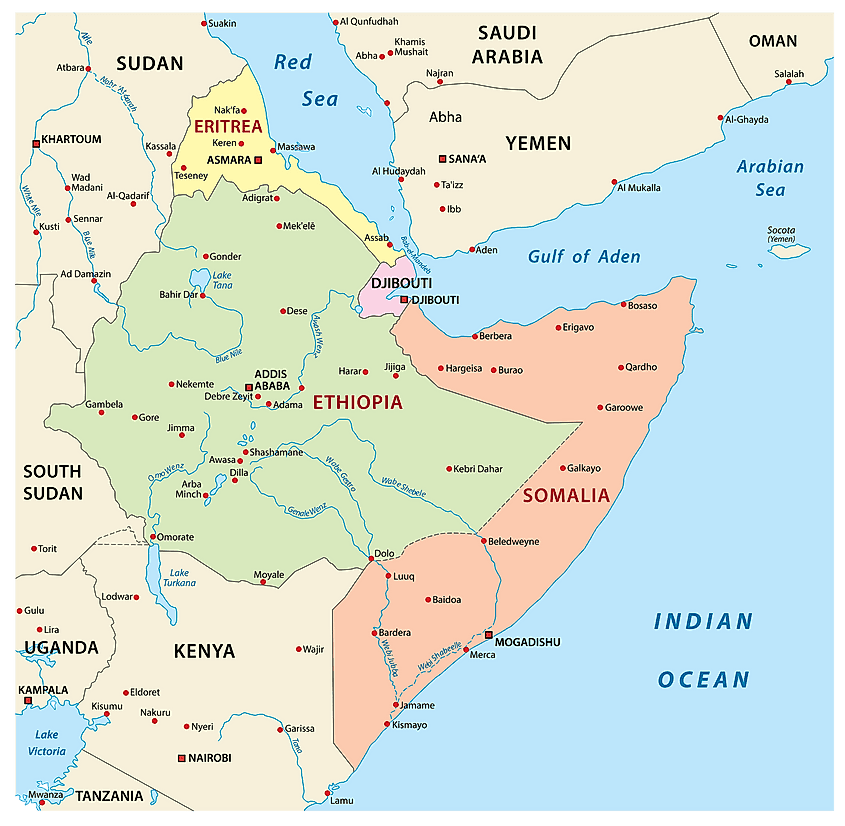


In an age where information is both a weapon and a shield, the role of authentic political analysts has become increasingly crucial, especially in volatile regions like the Horn of Africa. Recently, a lengthy and convoluted article penned by Adam Daud Ahmed, who identifies himself as a political and security analyst specializing in the Horn of Africa, graced the pages of the Ethiopian journal “Addis Standard.” While Ahmed’s writing may initially appear to be an earnest exploration of the region’s complex dynamics, a closer examination reveals a more insidious agenda: the promotion of secessionist movements and the elevation of Abiy Ahmed’s ambitions for geopolitical dominance-an access to the red sea. This essay seeks to dissect Adam’s arguments, exposing the underlying motivations and the potential consequences of his rhetoric.
The Case for Secession: Somaliland and Its Controversial MoU:
At the heart of Adam’s article lies a fervent advocacy for the recognition of Somaliland, a self-declared independent state that has sought international legitimacy since its unilateral declaration of independence from Somalia in 1991. Adam’s enthusiasm for Somaliland is not merely a call for recognition; it is intertwined with a specific partnership with the Ethiopia-backed DP World and a contentious Memorandum of Understanding (MoU) signed in 2024. The MoU, which has raised eyebrows due to its implications for regional stability and sovereignty, is portrayed by Adam as a beacon of progress to the imagination of the Ethiopian Oromo leadership.
However, Adam’s portrayal of Somaliland as a model of stability and governance is misleading. The reality is far more complex. Somaliland’s quest for recognition is fraught with challenges, including its fraught relationship with Somalia and the ongoing debates over its legitimacy. By framing Somaliland’s aspirations in a favorable light, Adam D. Ahmed not only oversimplifies a deeply intricate issue but also risks inflaming tensions between Somaliland and the Somali federal government. His advocacy for secession, under the guise of promoting self-determination, echoes a broader trend of destabilizing movements across the region including fragile Ethiopia, which could have far-reaching implications for the Horn of Africa.
The Abiy Ahmed Agenda: Geopolitical Ambitions and Foreign Collaborations:
Transitioning from the issue of Somaliland, Adam D. Ahmed shifts his focus to Ethiopian Prime Minister Abiy Ahmed, whose ambitions for a sovereign access to the Red Sea are presented as a noble endeavor. Adam’s analysis suggests that Abiy is driven by a desire to secure Ethiopia’s geopolitical interests, particularly in collaboration with foreign powers and financial giants. While it is true that access to the Red Sea is critical for Ethiopia—a landlocked nation—Adam’s framing of Abiy’s mad ambitions raises questions about the underlying motivations and the potential consequences of such pursuits in terms of international relations and norms and the condemnation resultant from grave violations that Ethiopia might be called to answer.
The strategic military aims that Adam D. Ahmed hints at are particularly alarming. The Horn of Africa is already a hotbed of geopolitical intrigue, with various foreign powers vying for influence. By promoting Abiy’s agenda without adequately addressing the implications of such collaborations, Adam seems to overlook the potential for conflict and instability. The specter of foreign intervention, whether through military alliances or economic dependencies, poses a significant threat to the sovereignty of nations like Djibouti and Somalia, which are already navigating their own complex relationships with foreign powers. The impact on Ethiopia itself could be paramount.
The Malicious Underpinnings: Stereotyping and Political Maneuvering:
One of the most troubling aspects of Adam’s article is his unverified critical assessments of sovereign states, particularly Djibouti, Somalia, Turkey, and China. By stereotyping these nations and labeling them as obstacles to progress, Adam reveals an amateurish understanding of the intricate web of relationships that define the Horn of Africa. His sweeping generalizations not only undermine the legitimacy of these states but also serve to bolster his own narrative, which is steeped in a particular brand of Oromism—a political ideology that often seeks to elevate the interests of the Oromo people at the expense of others.
The Somali proverb, “a fool does not see a bug on himself but sees the one on others,” aptly encapsulates Adam’s approach. Adam could idiologically contribute to the Ethiopian lamentable present situation. In his eagerness to criticize others, he fails to recognize the flaws within his own arguments and the biases that color his analysis. His unjustified maligning of the Oromo-led government’s policies further demonstrates a lack of objectivity, self-awareness and a willingness to manipulate narratives for political gain. This kind of rhetoric not only alienates potential allies but also perpetuates divisions within the region, hindering efforts toward unity and cooperation.
The Consequences of Malicious Rhetoric:
The implications of Adam’s article extend beyond mere academic discourse; they have the potential to influence public opinion and policy decisions in a region already grappling with significant challenges. By promoting secessionist sentiments and dangerously oversimplifying complex geopolitical dynamics, Adam risks exacerbating tensions and conflicts that could destabilize the region further. The Horn of Africa has a history of violent confrontations fueled by similar narratives, and the resurgence of such rhetoric could have dire consequences for peace and security.
Moreover, Adam’s article serves as a reminder of the power of narrative in shaping political landscapes. In an era where misinformation can spread like wildfire, the responsibility of political analysts to provide balanced and nuanced perspectives has never been more critical. Adam’s failure to fulfill this responsibility not only diminishes his credibility but also undermines the potential for constructive dialogue and collaboration among the nations of the Horn of Africa.
Conclusion: A Call for Responsible Analysis:
In conclusion, Adam Daud Ahmed’s article in “Addis Standard” exemplifies the dangers of biased and manipulative political analysis. While his intentions may be cloaked in the language of advocacy for self-determination and geopolitical ambition, the underlying motivations reveal a troubling agenda that could have far-reaching consequences for the Horn of Africa. As the region continues to navigate its complex challenges, it is imperative that analysts approach their work with integrity, seeking to foster understanding and cooperation rather than division and conflict.
The Horn of Africa deserves voices that prioritize peace, stability, and mutual respect among its diverse populations. In the face of Adam’s rhetoric, it is crucial for other analysts, policymakers, and citizens to engage in critical dialogue, challenge harmful narratives, and work towards a shared vision of a prosperous and united region. Only through responsible analysis and a commitment to truth can the Horn of Africa hope to overcome its historical challenges and forge a brighter future for all its people.