
The Historical Roots of the Selel-Awdal Crisis:
PART ONE
The situation unfolding in the Awdal region today has left many observers stunned and heartbroken. Families who once lived side by side, who built intimate bonds through marriage and shared community life, now find themselves caught in an atmosphere of unrest, conflict, and outright hostility. To understand how we arrived at this lamentable point, we must look beneath the surface of current events and examine the historical data and decisions that have shaped the present reality.
The Seeds of Division
The foundation of today’s conflict was laid during the colonial period. In 1954, as part of the independence process, the British colonial administration conducted a population census in the protectorate, with results published in March 1955. The population estimates for the Sayla-Borama districts placed the Issa community at approximately 55,000 and the Gadabuursi at 45,000, totaling 100,000 inhabitants. Based on these figures, five parliamentary seats were allocated accordingly: three for the Issa and two for the Gadabuursi.
At first glance, this appeared a straightforward administrative decision. However, a complication immediately emerged: the Mahad Casse sub-clan, though ethnically Gadabuursi, primarily resided in the Sayla district, which was largely dominated by the Issa. This geographical reality would soon become a point of intense political contention.
The Fateful Meeting
Recognizing an evident but inevitable default or anomaly in the census planning, Issa and Gadabuursi elders (Akils) were convened to resolve the seat allocation problem. Tribes of the Issa and Gadabuund lived geographically across district borders. In a display of good faith, the Issa delegation (Akils) acknowledged the problem and saw the logic in ceding one seat to the Gadabuursi regardless of the census results. But before signatures could be affixed, the Issa delegates posed a question that would echo through decades: “Will the partition be based on geographic reality or on ethnicity?” The intention was to cede one seat, to the Mahad Casse sub-clan. The question was so directed to the Mahad Casse sub-clan.
Promptly, the Gadabuursi Akils from Borama, not Mahad Casse, responded choosing ethnicity as the basis for partition. The Issa delegates recognizing the implication of the choice, commented: “The choice belongs to the Mahad Casse sub-clan.” Fortunately or unfortunately, the Mahad Casse elders present at the meeting insistently opted for the ethnicity option, supporting the Borama proposal. The meeting concluded with this understanding. Aware or unaware, the Mahad Casse missed the point, contributing to the present dilemma. They sent their political destiny to the Borama slaughter house.
Early Elections and Independence
The first-ever popular general elections in the protectorate took place in February 1959, electing thirty-two representived to take seat in a constituent assembly. The results for the Issa-Gadabuursi representation tell an important story: two Issa and three Gadabuursi were elected. Notably, the Mahad Casse did not present a candidate in this election. This same constituent parliament would go on to celebrate independence on June 26,1960, and voted for the Act of Union that proclaimed the birth of the Somali Republic on July 1, 1960.
The second parliamentary election in July 1964 brought the underlying tensions to a head. Borama district elected three Gadabuursi MPs, while the Issa of Sayla district elected two MPs, not through popular suffrage but nominated unopposed by the Issa Guddi (the council of forty-four). This time, the Mahad Casse sub-clan presented a candidate—but the candidate of the Mahad Casse, a Djiboutian, had to be registered in Borama. The Gadabuursi of Borama opposed this candidacy vehemently, defying the the partition agreement where the Issa clan ceded the seat to honor the Mahad Casse sub-clan.
Their reasoning: the Mahad Casse sub-clan resided in Sayla district and therefore had no right to present a candidate in Borama. The situation escalated rapidly. The Mahad Casse office in Borama was destroyed, their party’s flag burned and their candidate humiliated.
The third general election came with renewed tensions.
In May 1969, the electoral process began in earnest. The Issa Guddi, a council of 44 Issa elders, was summoned to the Dry River of Selel, Elgal, a village that had become a symbolic gathering place for the community. The Guddi was tasked with appointing the two Members of Parliament (MPs) to represent the district in the national assembly.
As June unfolded, the atmosphere grew increasingly charged. Reports emerged that eight trucks, laden with 400 men, were en route to Sayla to bolster the campaign of a particular candidate from the Mahad Casse sub-clan. The arrival of these trucks was not merely a logistical maneuver; it was a potential flashpoint that threatened to ignite existing tensions. The Issa youth, fiercely protective of their community and wary of external interference, could not remain passive in the face of what they perceived as an invasion.
On that fateful evening, the convoy was intercepted and halted. The sight of the trucks, brimming with thousands of men , was enough to incite fury among the Issa youth. Armed and ready to defend their rights, they rallied together, their emotions fueled by a mix of indignation and a deep-seated desire to protect their autonomy. The elders, however, recognized the gravity of the situation. They understood that the path forward required wisdom and restraint, not violence.
In a remarkable display of leadership, the Issa elders mobilized a heavy security force to manage the escalating situation. Their goal was clear: to avert catastrophe and maintain peace within the community. The elders approached the assailants with a blend of authority and compassion. Instead of escalating tensions, they chose to dismount the men from the trucks, providing them with food and water, a gesture that spoke volumes about the Issa values of hospitality and community.
The operation concluded without incident, a testament to the strength of the Issa leadership and the collective resolve of the community. By safeguarding the outsiders and ensuring their safe return home, the following morning, the Issa elders demonstrated that the true measure of strength lies not in the capacity for violence but in the ability to forge understanding and maintain peace.
Prime Minister Mohamed Haji Ibrahim Igal, bearing witness to these events, offered a poignant observation in Somali: “Laba qaydhiin ku qaybtantay bisayl iskuma cawrido”—a Somali proverb meaning ” a peace of meat partaged raw cannot be disputed”. Another African proverb perfectly relevant is: “Two rams cannot drink from the same waterskin”. An Arabic proverb applies equally here: if you honor a noble, he will thank you, but if you honor a base person, he will repay you with evil.
From Historical Grievance to Present Crisis
What we witness in Awdal today is not a spontaneous eruption of violence but the logical culmination of seven decades of unresolved tension. The choice made in that fateful meeting—to base political representation on ethnicity rather than geography—created a structural contradiction that has never been adequately addressed. The Mahad Casse, caught between ethnic identity and geographic reality, became a perpetual point of contention. A pertinent question is: Who to blame?. The blame definitely falls on the courtyard of an innocent Mahad Casse and his malicious brothers- Makahil and Afaan who profited from a brother who missed the right decision to safeguard his interest.
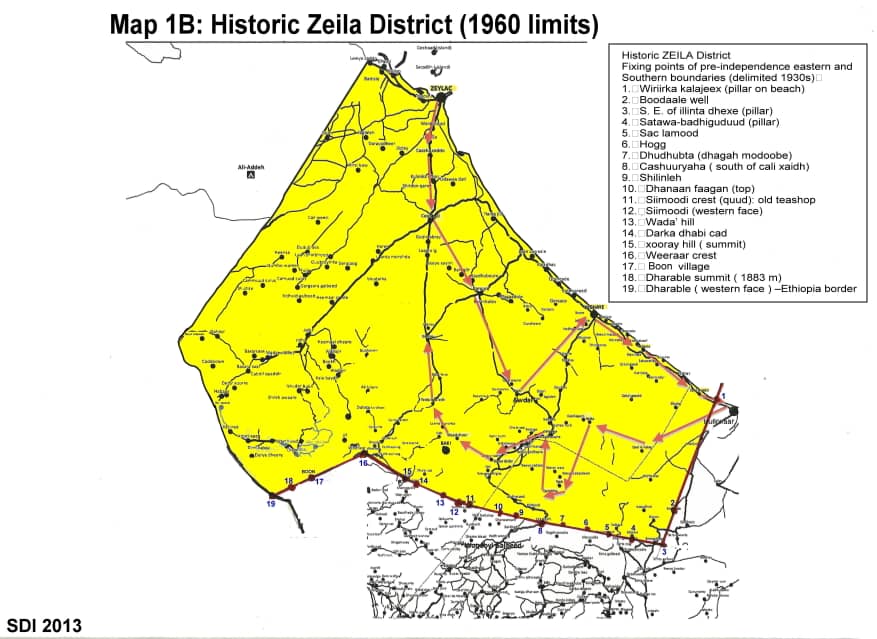
This historical wound has festered, producing increasingly bold claims of sole ownership over Saylac, the Awdal, Selel, and even Gabiley regions. For years, many dismissed these developments as simple rhetoric. The Gadabuursi of the Borama-Baki area were seen by some as having lost perspective, while most citizens (Issa) in the Sayla-Lughaya area interpreted the daily interventions as posturing rather than serious threats.
But the observable provocations accumulated: hate speech, threats, insults, and intimidation dominated media platforms with increasing intensity. Each incident built upon the last, normalizing hostility and eroding the bonds of brotherhood that once united these communities. The “explosive moment” we now face did not arrive without warning—it was announced by every sign along the way.
Understanding What Went Wrong
To understand how brothers and sisters who once built families together now prepare for a bloody conflict, we must recognize that political decisions have consequences that outlive their makers. The 1954 census, the 1955 meeting of elders, the elections of 1964 and,1969,—these are not merely historical footnotes but the architecture upon which present realities rest.
When communities are reduced to political calculations, when ancient ties of marriage and neighborliness are subordinated to ethnic arithmetic, we should not be surprised when those ties break. The Mahad Casse question was never merely about one sub-clan’s representation—it was about whether geography or ethnicity would define belonging, whether neighbors would remain neighbors or become competitors, whether faithfulness will prevail or greed and malice will dominate and whether brothers will remain brother or deception, egoism and dishonest manners continue to triomph.
Today, as Awdal faces its gravest crisis, we would do well to remember that the rams fighting over the waterskin once drank from it together. The challenge before us is not merely to restore peace but to rebuild the understanding that no community’s honor requires another’s humiliation, and no political solution is sustainable that does not acknowledge both the ethnic and geographic realities of those who call this land home.
The data is clear. The history is documented. The question that remains is whether we have the wisdom to learn from it before more is lost than can ever be recovered.
………………
In PART TWO we will dive deeper into the subject.