
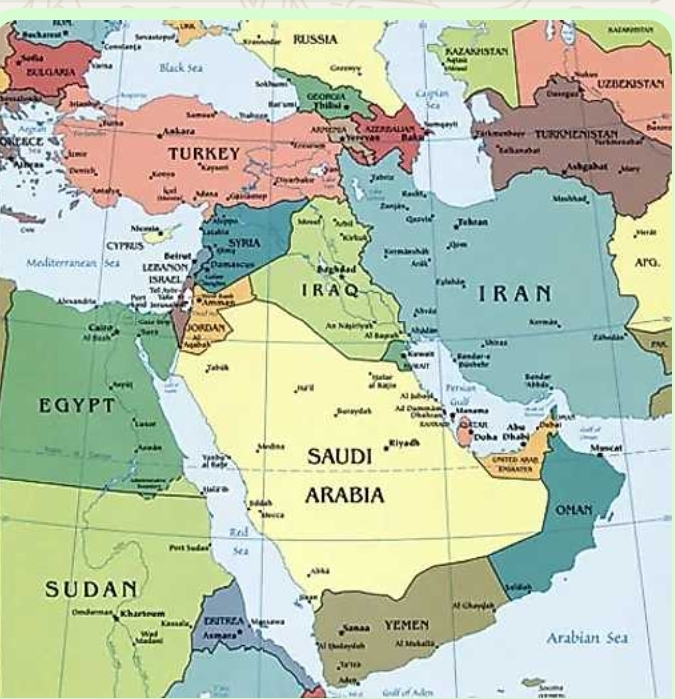
The Middle East: A Descent into Annihilation
In the grand tapestry of world history, the Middle East has often been a focal point of conflict, power struggles, and ideological battles. Today, as we witness the disintegration of societal structures and the erosion of hope, it is crucial to examine the forces that have contributed to this degeneration. The Middle East is not merely a region; it is a microcosm of the broader global dynamics that threaten to plunge humanity into an abyss of chaos and violence. The West’s shift from democracy to authoritarianism, from civilization to barbarism, and from collective decision-making to unilateralism within the UN, has not only destabilized the region but has also set the stage for a potential third world war if the Israelo-Arab conflict and the nuclear crisis of Iran are not solved rightly by the rightful UNO’s instances.
The post-World War II era was characterized by a collective effort to establish a world order rooted in democratic ideals and mutual respect. The defeat of Nazism and fascism heralded a new age of hope, where nations sought to build bridges rather than walls. However, this period of optimism was short-lived. The rise of dominant powers, driven by greed and a thirst for hegemony and domination, led to the emergence of authoritarian regimes that stifled dissent and obliterated the very principles of democracy they once championed. In this context, the Middle East has become a battleground for competing interests, where the ideals of justice and harmony have been sacrificed at the altar of absolute power.
The creation of Zionism, while initially a response to centuries of persecution, in the West, has morphed into a source of conflict that exacerbates tensions in the region. The establishment of Israel in 1948, followed by decades of harsh occupation, genocide and violence, has left a deep scar on the Palestinian people and has fueled extremism across the regioon. This cycle of violence has given rise to groups like Al-Qaeda, ISIS, and Al-Shabaab, which pretend to for national cause while exploiting the grievances of marginalized communities to further their agendas and fighting proxi wars. In this way, the very powers that once fought against Nazism and fascism have inadvertently sown the seeds of terrorism and extremism, creating a toxic environment that perpetuates suffering.
The destruction of countries such as Iraq, Libya, Yemen, Soudan, Afghanistan, Somalia and now Iran, has further compounded the crisis. The invasions and subsequent destabilization of these nations have not only led to immense human suffering but have also created power vacuums that extremist groups have eagerly filled. The humanitarian crises that ensued have drawn little more than lip service from the international community, revealing a troubling hypocrisy. The United Nations, an institution designed to promote peace and cooperation, has been rendered ineffective in the face of unilateral actions taken by powerful nations. The principles of collective decision-making and diplomacy have been overshadowed by the whims of a few, leaving the world teetering on the brink of annihilation.
As the specter of a unipolar world looms large, the implications for the Middle East are dire. The desire to eliminate any semblance of a bipolar world order has led to aggressive posturing against nations like Iran, Russia, and China. The rhetoric of “us versus them” has become a rallying cry for those who seek to consolidate power, often at the expense of innocent lives. The push for dominance is not merely a geopolitical strategy; it is a manifestation of a deeper malaise that threatens to engulf humanity in a new era of barbarism.
The consequences of this trajectory are profound. The Middle East, once a cradle of civilization, is now at risk of becoming a graveyard of cultures, ideologies, and dreams. The erosion of justice in the West and the rise of extremism have created a landscape where the rule of law is but a distant memory. The humanitarian crises that have unfolded are not just statistics; they represent the lives of real people—families torn apart, communities shattered, and futures obliterated. The apathy of the international community in the face of such suffering is a stark reminder of the moral decay that accompanies the pursuit of power and wealth.
As we stand on the precipice of uncertainty, it is imperative to ask ourselves: what kind of world do we want to create? The attitudes we witness today, marked by division and arogant hostility, threaten to drag humanity into an inhumane abyss. The rhetoric of leaders who espouse violence and exclusion only serves to deepen the chasm that separates us. If we are to avoid the impending catastrophe, we must reclaim the ideals of justice, compassion, and collective responsibility.
In conclusion, the degeneration of the Middle East into a state of potential annihilation is not an isolated phenomenon; it is a reflection of the broader global trends that prioritize power over people. The shift from democracy to authoritarianism, the rise of extremism, and the erosion of international cooperation have set the stage for a crisis that could have catastrophic consequences. As we navigate these turbulent waters, it is essential to recognize our shared humanity and work towards a future that embraces justice, peace, and mutual respect. The path ahead may be fraught with challenges, but it is a journey we must undertake if we are to avert the darkness that threatens to engulf us all.l