
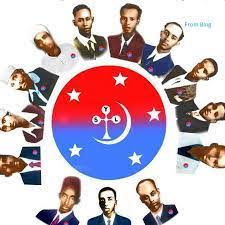
The Petitions to the United Nations: A Complex Tapestry of Somali Nationalism:
In the late 1940s, Somalia found itself at a pivotal crossroads, a moment marked by a confluence of aspirations for independence and deep-seated clan rivalries. As the world emerged from the shadows of World War II, the United Nations became a platform for various Somali factions to articulate their visions for the future of their nation. The petitions submitted to the UN Trusteeship Council and the Four Power Commission during this period reveal a multifaceted political landscape. While the Somali Youth League (SYL) and the Issa delegation emerged as prominent representatives of nationalist sentiment, they were not the sole voices in the discourse. A diverse array of clan groups, political parties, and interest factions presented their own petitions, each reflecting unique agendas and concerns.
The Somali Youth League: A Voice for Pan-Somali Nationalism:
At the forefront of the nationalist movement was the Somali Youth League (SYL), which sought to unify all Somali territories under a single banner. The SYL’s vision was grounded in the ideal of “Greater Somalia,” a concept that resonated deeply with many Somalis who yearned for independence from colonial rule. The SYL argued for a transition from British and Italian trusteeship to immediate independence, believing that unification was not only a matter of political necessity but also of cultural identity. However, this vision was not universally embraced; Although SYL enjoyed public support, it faced significant opposition from various clan members and factions who feared that their interests would be overshadowed by the dominant narrative of the SYL. SYL and opposing factions diverged on the questions of immediate independence and Trusteeship. Opposing factions pushed for the election of Italy for the 10-year mission.
Clan-Based Factions: The Hawaḍle and Marehan Groups:
Two notable factions that opposed the SYL’s agenda were from Hawaḍle and Marehan groups. Both groups, primarily from central and southern Somalia, expressed profound apprehensions regarding the SYL’s leadership, which they perceived as heavily influenced by certain groups of the Darod and Hawiye clans. In their petitions, the Hawaḍle articulated a strong anti-SYL stance, advocating for a prolonged Italian trusteeship. They argued that such an arrangement would help maintain order and provide a necessary buffer against the perceived marginalization they would face in an independent Somalia. Similarly, the Marehan clan,group also skeptical of the SYL’s intentions, echoed these sentiments, fearing that their political aspirations would be eclipsed by the SYL’s dominance.
The Somali National League (SNL): A Rival Voice:
In the northern regions of Somalia, the Somali National League (SNL) emerged as a rival to the SYL, representing primarily the interests of the Isaaq clan. The SNL shared the SYL’s nationalist sentiments but was wary of the SYL’s influence, particularly its southern dominance. Their petitions reflected a dual strategy: while they advocated for the unification of Somali territories, they were also prepared to pursue independence for British Somaliland independently if necessary. This approach highlighted the complexities of clan politics, where loyalty to one’s clan often took precedence over broader nationalist aspirations.
The Hisbia Digil Mirifle: A Different Perspective:
The Hisbia Digil Mirifle (HDM), representing the agro-pastoral Rahanweyn clans of the inter-riverine region, provided yet another perspective in this intricate political landscape. Fiercely anti-SYL, the HDM’s petitions expressed a profound fear of domination by the nomadic pastoralist clans that largely led the SYL. Their support for Italian trusteeship stemmed from a desire to protect their unique socio-economic structure and political interests. The Rahanweyn’s distinct way of life and their apprehensions regarding the SYL’s agenda underscored the diverse motivations that shaped the petitions submitted to the UN.
The Benadir Youth Union: Urban Elites and Economic Interests
In the coastal city of Mogadishu, the Benadir Youth Union emerged as a voice for urban elites, including merchants and those of mixed Somali-Italian heritage. Their pro-Italian stance was rooted in economic pragmatism; they believed that Italy possessed the experience and capital necessary for the development of Somalia. The Benadir Youth Union argued that a swift transfer of power to the SYL could jeopardize the economic stability of the coastal cities, which thrived on a cosmopolitan blend of cultures and trade. Their petitions highlighted the intersection of economic interests and political aspirations, illustrating the varied motivations that influenced the political discourse of the time.
Other Pro-Italian Factions: The Collaborators:
In addition to these prominent groups, a variety of smaller clan associations and political factions—often labeled by the SYL as “collaborators” or “the bowed-down”—also submitted petitions supporting the return of Italy. These factions were typically composed of individuals who had benefited from the colonial administration or who viewed Italian rule as a lesser evil compared to the potential domination by rival clans under the SYL. Their petitions underscored the complexities of Somali nationalism, revealing a spectrum of opinions that challenged the notion of a singular national identity.
A Tapestry of Voices:
The flood of petitions submitted to the United Nations painted a complex picture of Somali nationalism. While the SYL represented a significant portion of the Somali population and articulated a passionate demand for independence, it was evident that the political landscape was far from unified. The petitions revealed a mosaic of interests, fears, and aspirations, where the ideal of a unified Somalia often clashed with clan-specific concerns. The SYL’s vision of nationalism was met with resistance from various Somali factions that sought to protect their own political and economic interests, leading to a fragmented nationalist movement.
Conclusion: A Compromise and Its Implications:
Ultimately, the United Nations faced the daunting task of reconciling these competing interests. The diverse petitions underscored the challenges of achieving a unified Somali state, where the aspirations for independence were entangled with fears of domination and marginalization. This division played a crucial role in the UN’s decision to compromise on a 10-year Italian trusteeship, aiming to balance the passionate demands for independence with the concerns of those wary of the SYL’s vision. The legacy of this complex political landscape continues to resonate in contemporary Somalia, where clan dynamics and rivalries still shape the nation’s political discourse.
n reflecting on this pivotal moment in Somali history, it becomes clear that the petitions to the United Nations were not merely a series of requests for independence; they were a testament to the intricate interplay of identity, power, and aspiration that defines the Somali experience. As the nation continues to navigate its path forward, the echoes of these early petitions serve as a reminder of the complexities that lie at the heart of Somali nationalism.