



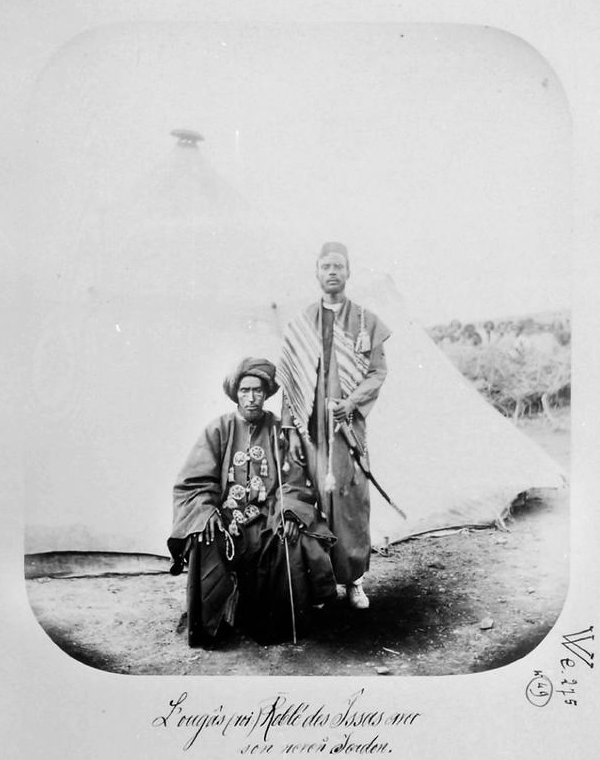
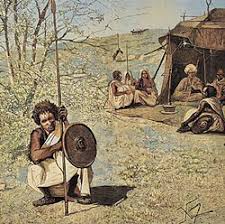
Ugaas Robleh Farah: The Rain Prince of the Issa
A Portrait from the Margins of Empire
In the mid-nineteenth century, when European explorers penetrated the Horn of Africa seeking the source of the Nile or routes to the fabled markets of Harar, they encountered a leader whose reputation preceded him across the arid plains. Ugaas Robleh Farah, known to his people as the “Rain Prince,” ruled the Issa Somali Nation during a period of profound regional transformation. The written record of his appearance and character comes to us through the accounts of two explorers whose paths crossed his: the Italian Antonio Cecchi and the Austrian Philipp Paulitschke. Their descriptions, necessarily filtered through European eyes, nonetheless capture something of the man who would shape the commercial and political geography of the Zeila-Harar corridor and hinterlands.
Cecchi, who visited the Ugaas at his seat of power, left a vivid portrait. He described a tall man with slender limbs, a crushed nose, and features marked by smallpox, yet possessing a “smart eye” and an unmistakable commanding presence. The Ugaas dressed in a manner that reflected his position between worlds—Turkish trousers, a canvas mantle, and a turban-wrapped tarbush adorned with papers and amulets. This sartorial mixture of Ottoman, European, and Islamic elements was not mere fashion but a statement of his diplomatic reach. Cecchi noted his kind manners, his oratorical skill, and his playful rapport with subjects, qualities that would prove essential during the crises of his reign. Paulitschke, arriving in 1884, encountered a towering, dark-complexioned figure with a thin face and prominent cheekbones, dressed in a white coat and heralded by guards who announced him as the Rain Prince. The Austrian explorer observed that the Ugaas was eager to hold diplomatic audiences—a sign of a leader who understood that his power depended on engagement with the outside world.
The Burden of Spiritual Authority
To understand Ugaas Robleh’s reign, one must first understand the institution he embodied. Among the Issa, the Ugaas was not merely a political chief but a spiritual intermediary between heaven and earth. His title as “Rain Prince” reflected the belief that the prosperity of the land—the fertility of pastures and the survival of herds—was bound to his spiritual alignment. This was a sacred covenant, but it was also a precarious one. When drought struck, the people did not simply endure; they asked why. And in the 1860s, during a devastating drought that dried up grazing lands and decimated livestock across the Horn, the elders of the Issa nearly reached a conclusion: the Ugaas had lost his favor with the divine.
The ritual deposition that could follow was not a rebellion but a constitutional act. Under the Issa Xeer—the customary law that governed all aspects of communal life—the Ugaas served as a constitutional arbiter rather than an absolute monarch. His authority was conditional on his ability to maintain the collective fortune of the community. When the rains failed, the elders stripped him of his titles and ceremonially shaved his head, severing his symbolic connection to leadership and heaven. This was a profound humiliation, but it was also a mechanism of accountability embedded in pastoral democracy. The Ugaas was not above the law; he was its servant.
Yet Robleh Farah was not a man to accept exile. His oratorical mastery, his personal charisma, and his political indispensability eventually allowed him to remain or reclaim his seat. The act of shaving had been meant to sever his connection to power, but it had not severed his connection to the people. By the time he moved his capital to Jaldessa, he had proven that his leadership was not merely ceremonial but essential to the survival of the Issa.
The Strategy of Jaldessa
The relocation of his seat to Jaldessa was a masterstroke of political geography. Around 1875, Egyptian forces had stabilized a garrison in the town as part of their ill-fated invasion of Harar. Rather than resist the foreign presence, Ugaas Robleh positioned his administration at this exact boundary between the Issa and the Oromo—the two peoples whose lands straddled the vital trade routes running between the coastal port of Zeila and the inland hub of Harar. From this position, he became the absolute gatekeeper of regional commerce.
The logic of his strategy was both simple and profound. Jaldessa sat at the intersection of multiple worlds: the coast and the interior, the Somali and the Oromo, the Islamic sultanates and the Christian highlands. Whoever controlled Jaldessa controlled the flow of goods, people, and information. The Egyptians, the French, the British, and the Abyssinians could all project power, but none could bypass the Ugaas. His authority was not military in the conventional sense—he did not command a standing army—but it was backed by the implicit threat of tens of thousands of warriors who could be summoned at a moment’s notice. Cecchi noted that the Ugaas could rapidly assemble a massive force when conflicts arose, earning him a terrifying reputation among regional rivals. This was not an army of conquest but of deterrence; its purpose was to ensure that no caravan passed through Issa lands without paying tribute.
The Architecture of Trade and Tribute
Ugaas Robleh’s reign coincided with the height of the “Scramble for Africa,” when European powers were partitioning the continent and regional empires were jostling for control of trade routes. His response was not resistance but negotiation—a policy that allowed him to extract maximum benefit from every foreign presence while maintaining his own autonomy.
When Egyptian forces garrisoned Jaldessa in 1875, the Ugaas did not fight them recklessly. Instead, he structured a deal that allowed the garrison to remain in exchange for formal recognition of his authority and a heavy tax levy. Records show he imposed an immediate tribute of fifty Maria Theresa thalers and premium cotton textiles on incoming foreign expeditions. This was not extortion but statecraft: the Egyptians gained a foothold, but the Ugaas gained revenue and legitimacy. The arrangement allowed him to present himself to his people as a leader who could manage the foreigners without submitting to them.
As the French began establishing their presence in what is now Djibouti, Ugaas Robleh and his sub-chiefs negotiated treaties of commerce and friendship. French archival records outline agreements between commanders like Léonce Lagarde and senior Issa leaders—including figures aligned with Ogaas Roble Robleh such as Absi Handet, Roblé Eouk, and Guedi Dagah—securing trade caravans under French protection. These treaties were not capitulations; they were partnerships in which the Issa provided safe passage in exchange for compensation and diplomatic recognition. The Ugaas understood that the French, like the Egyptians, needed him more than he needed them.
Perhaps the most telling testament to his power came from Abyssinia. Emperor Menelik II, who would later forge the Ethiopian empire through conquest and diplomacy, recognized that he could not move goods safely to the coast without the Ugaas’s blessing. Menelik routinely sent imperial trade envoys offering formal tribute and gifts to prevent Issa warriors from raiding royal caravans. The future emperor of Ethiopia, who would defeat the Italians at Adwa and expand his realm to the sea, chose to pay tribute to a Somali Issa Ugaas rather than risk his commercial lifelines. This was not weakness but pragmatism; the Ugaas controlled the gates, and even emperors had to knock.
The Balance of Power
The Issa Xeer, which governed Ugaas Robleh’s reign, was more than a legal code; it was a philosophy of governance. It placed strict checks and balances on the Ugaas, ensuring that his power served the collective good rather than personal ambition. The rule of celibate succession—which prevented the Ugaas from fathering dynasties—was perhaps the most striking of these checks. The Ugaas was chosen from a pool of eligible candidates, not born to rule. His authority depended on consensus, expressed through the grand assembly known as the Shir of the Grande. The elders could elevate him, and they could depose him. The attempted shaving ritual of 1860 was not an aberration but an affirmation of this principle.
Yet within these constraints, Ugaas Robleh exercised considerable power. His 40,000-strong warrior force was not a standing army but a network of alliances and obligations that could be activated in times of war. His diplomacy extended from the Red Sea coast to the Ethiopian highlands. His seat at Jaldessa was not merely a capital but a crossroads of continents, where Arab traders, Somali pastoralists, Oromo farmers, French diplomats, and Abyssinian envoys all sought his favor.
Legacy
Ugaas Robleh Farah died in the late nineteenth century, leaving behind a nation that had navigated the perils of colonialism without losing its autonomy. His lineage continued amidst the pressures of European expansion, and the spiritual and cultural traditions of the Issa Ugaas remain deeply revered today. His strategy of positioning himself at the boundary between worlds—between Issa and Oromo, between coast and interior, between tradition and modernity—allowed him to become the gatekeeper of a vital corridor of commerce and communication.
The explorers who recorded his appearance and words have long since passed, and the empire he navigated has been partitioned and repartitioned. Yet the “Rain Prince” endures in oral tradition and historical memory, a reminder that power in the Horn of Africa was never merely a matter of military force. It was a matter of position, negotiation, and the ability to command the respect of those who passed through one’s lands. Ugaas Robleh Farah mastered these arts, and in doing so, he shaped the history of a region that would remain contested long after his death.