



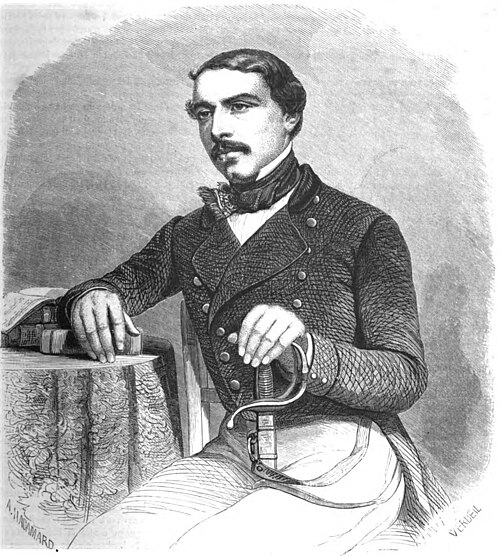
The murder of the French Councilor, Henry Lambert
The murder of Henri Lambert in June 1859 was not merely a criminal act but the violent culmination of a fierce commercial and political rivalry on the Somali coast, a rivalry in which the Issa clan and their Ogaas played an indispensable role. The French consular agent’s death, orchestrated at sea, exposed the fragile alliances, the strategic use of Issa sailors, and the complex interplay between coastal governors, Ottoman authorities, and European powers.
Sharmarke Ali Saleh and His Marine Fleet
Sharmarke Ali Saleh, born around 1775 in Maydh, belonged to the Habr Yunis sub-clan of the Isaaq. He began his career as a Nakhuda—a captain of a Somali vessel—and a trader, and by the 1840s he had become one of the wealthiest men on the African continent, earning the sobriquet “the African Rothschild”. Operating from small port (Farah), between Berbera and Lughaya, his power rested on a marine fleet that allowed him to control the maritime approaches to Zeila, Berbera and the Gulf of Aden. In 1841, he used a flotilla to depose Zeila’s Arab governor, and in 1855 he assembled a fleet of eight ships to besiege the town and expel his rival, Abubakr Pasha. This fleet was not merely a military instrument; it was the commercial backbone of his customs empire, enabling him to monopolize trade from Zeila to Berbera and beyond, to the Yemen coasts.
Issa Sailors and the Maritime Labour Force
Sharmarke’s ships were crewed predominantly by Issa Somali sailors, a clan whose homeland encompassed Zeila and its hinterland. The Issa were a northern Somali clan of the Dir family, known for their martial traditions and their control of the caravan routes that linked the coast to the interior. For Sharmarke, employing Issa sailors was both a practical necessity and a political strategy: it bound the clan’s maritime workforce to his commercial interests and ensured that his vessels could move through waters where Issa networks held sway. The crew of the Nasseri, the dhow on which Henri Lambert was murdered, was composed of men from Zeila, inclussively Issa sailors such as Assooah Gedy, whose later testimony would become central to the British investigation.
Political, Economic, and Security Relations with the Issa Hinterland
Sharmarke’s relationship with the Issa and their Ogaas was the foundation of his governance. Economically, he depended on the Issa to keep the caravan routes open between Zeila, Harar, and the Ogaden. His governorship, as the historical record notes, had an “instant effect” on Zeila because he “maneuvered to monopolize as much of the regional trade as possible, with his sights set as far as Harar and the Ogaden”. Politically, he cultivated allies among the Issa elders and the Ughaz (paramount sultan), understanding that without their cooperation, no governor could hold Zeila. Security was inseparable from this arrangement: the Issa could protect or plunder caravans, and Sharmarke’s subsidies and gifts to the Ogaas were designed to secure their loyalty. His rival, Abubakr Pasha, similarly sought Issa goodwill, but Sharmarke’s deeper roots in the Somali interior gave him a decisive advantage in mobilizing clan networks when his interests were threatened.
The Invitation to Murder Lambert
The murder of Henri Lambert was, according to multiple investigations and confessions, directly ordered by Sharmarke. Lambert, a former French consular agent in Aden, was a supporter of Abubakr Pasha, Sharmarke’s chief rival for control of Zeila’s customs revenue. In 1859, as Lambert prepared to sail from Mokha to Tadjoura aboard the Nasseri, Sharmarke dispatched two emissaries, Aly Bar Omar Tour and Mohamed Hassan Robly, with a letter demanding Lambert’s death. The letter was delivered to Aouat Bel Fakil, a former banker of Sharmarke, who forwarded it to Ahmed Pasha of Al-Hodeydah, who consented to the execution. The emissaries then approached the ship’s captain, Abdul Ahy, an Issa sailor native of Zeila, and through a combination of promises and threats secured his cooperation. Abdullahy was given a written order bearing Sharmarke’s seal, the owner of Nasiri, guaranteeing his protection, and with the support of his crew— all Issa sailors—he carried out the murder on 4 June 1859 at Île Moucha, killing Lambert and his two servants and scuttling the boat.
The Retaking of Zeila
Sharmarke’s campaign to retake Zeila was inseparable from his feud with Abubakr Pasha. After losing the customs lease to Abubakr in 1857, Sharmarke sought to reclaim the town by force. In February–March 1855, he assembled a fleet of eight battleships and launched a siege of Zeila, supported by Mohamed Diban and other allies. Although the siege was inconclusive—Abubakr fled the town, and Sharmarke ultimately abandoned the position—it demonstrated his willingness to use maritime power to challenge his rival. The campaign was part of a broader pattern: Sharmarke’s control of Zeila was never secure, and his rivalry with Abubakr repeatedly spilled into open conflict, with the Issa often caught in the middle as both potential allies and potential targets.
The Investigation and the Role of Issa Elders and their Ogaas
The investigation into Lambert’s death revealed the centrality of Issa elders and their Ogaas in the administration of justice. When the French dispatched Captain Playfair to investigate, he interviewed Issa witnesses, including the sailor Assooah Gedy, whose account of an accidental shipwreck was accepted by the British despite evidence of foul play. Meanwhile, the French commander De Langle pursued a more aggressive inquiry, during which Abdillahi bin Edlie, an accomplice, confessed to the murder and implicated Sharmarke and Ahmed Pasha. De Langle’s handling of the case earned him the respect of the Somali tribes, who viewed him as honourable. The Ughaz, Roble Farah, the 14th Ughaz of the Issa, was drawn into the affair: he had exchanged letters with Rear-Admiral De Langle, and although he was later nearly dethroned—with people saying he had brought punishment from Heaven by delivering Lambert’s alleged murderers to France—his involvement underscores the extent to which the Issa Ogaases were expected to cooperate with foreign investigations and to deliver suspects to colonial authorities. The guilty parties were eventually tried in Constantinople to be handed to France for equitable jailing, but Sharmarke died of an aneurysm aboard the Somme in Jeddah before justice could be fully served, expressing remorse in his final days. The Issa Nakhuda of Nasiria, accused of the murder, himself, mistoriouly died en route to France provoking the wrath of Issa Gande for the responsibility of an unusual handing of an Issa person to foreigners, inspite of the fact that Othmans promised that the accused will undergo a fair trial in Istanbul and a safe return home.
The murder of Henri Lambert thus illuminates a world in which Issa sailors, elders, and Ogaas were not passive bystanders but active participants in the political, judicial and commercial struggles of the Somali coast. Sharmarke Ali Saleh’s marine fleet, crewed by Issa sailors, was both an instrument of his power and a conduit for the violence that his rivalry with Abubakr Pasha unleashed. The investigation that followed exposed the fragility of justice in a region where Ottoman, British, and French interests collided, and where the authority of the Issa Ogaas could determine the fate of 0 and the reputations of colonial officers alike.