



The Ethiopia’s Aquisition of Su-35s fighters and M-400 batterie’s: The Gap between delivery announcement and confirmed reality.
The single most consequential development since the initial announcement is not the arrival of the Su-35s themselves, but the gap between the announced delivery and the confirmed reality—and the way Ethiopia’s adversaries have exploited that gap to accelerate a coordinated encirclement. What was an emerging alignment around Egypt in late October has, by mid-November, become an operational pressure network with a concrete military dimension on Ethiopia’s northern border. The acquisition has not deterred this network; it has given it a rationale, a timeline, and a set of vulnerabilities to target.
The Delivery Gap: Deterrence Declared, Deterrence Deferred
Ethiopia’s announcement on 28 October claimed receipt of twelve Su-35s. Russia’s state arms exporter, Rosoboronexport, confirmed to Reuters that the first delivery consisted of two aircraft; images released during Abiy Ahmed’s Moscow visit showed only two Su-35s bearing Ethiopian markings. The delivery schedule for the four S-400 batteries, their deployment locations, and financing remain undisclosed. This is not a minor discrepancy. It means Ethiopia’s advertised air-power revolution is, for now, a symbolic capability rather than an operational one. The S-400s—the systems that would actually create the anti-access bubble that worries Egypt and Eritrea—are not yet in the country, and their arrival timeline is opaque. The deterrence value of the package is therefore declaratory, not deployed, and Ethiopia’s adversaries have read the gap accurately.
The Northern Front: From Proxy Allegation to Direct Confrontation
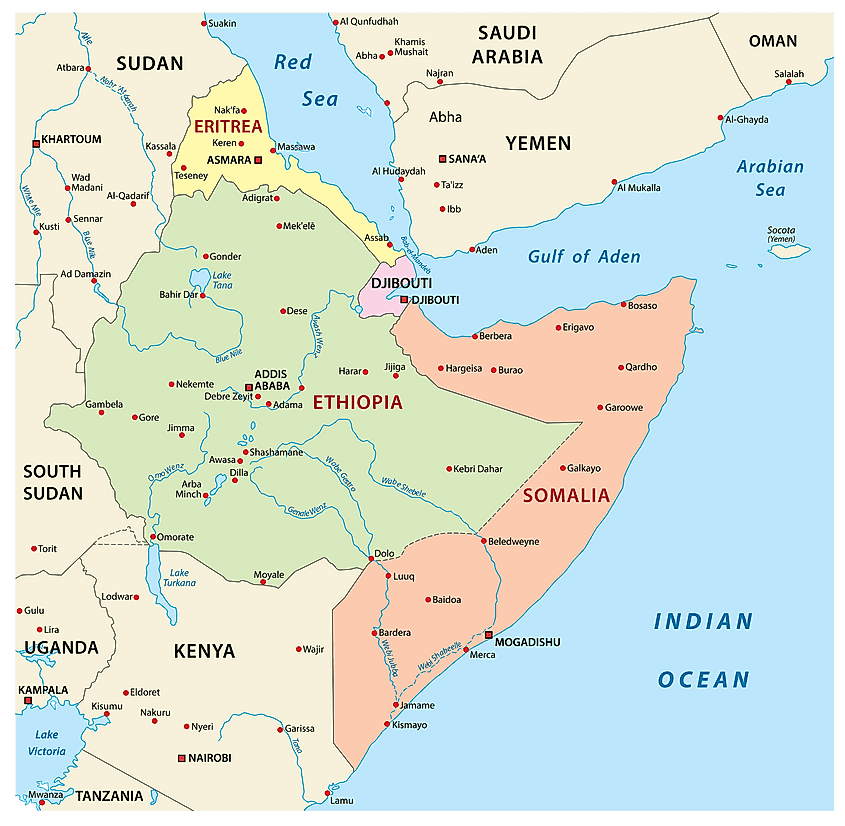
The internal and external dimensions of Ethiopia’s security crisis have fused. On 14 November, Ethiopia’s military chief, Field Marshal Birhanu Jula, accused Eritrea of directing a new TPLF offensive targeting federal positions across Amhara and Afar regions, alleging that Egypt supplied weapons and logistical support to the rebels in a coordinated campaign to overthrow the government. He claimed the attacking commanders fled to Eritrean towns after their defeat. Eritrea and Egypt have previously rejected such accusations and did not immediately respond.
Simultaneously, the border itself has become a theatre of direct exchange. Conflict monitors documented drone strikes and heavy artillery fire near Badme, with Ethiopian drones targeting likely Eritrean positions around 12 November and Eritrean forces firing artillery toward Ethiopian positions. Ethiopia and Eritrea have amassed forces along their shared border, bringing the two armies within striking distance of each other. Ethiopian forces captured the town of Sheraro on 3 November and advanced toward the border, while Eritrean forces positioned themselves near Badme’s perimeter. The G7 foreign ministers, meeting in Paris on 9–10 November, expressed “great concern” and urged maximum restraint. Diplomatically, the rupture is complete: Ethiopia closed its embassy in Asmara and expelled Eritrean diplomats on 1 October, and Eritrea cut ties entirely.
The “enemy” in Ethiopian official discourse is now explicitly a tripartite axis of Eritrea, Egypt, and the TPLF, with Sudan and the Fano militia alleged as junior partners. The Su-35s, in this framing, were meant to deter Eritrean air power and Egyptian long-range strike options; instead, their incomplete delivery has coincided with the most dangerous escalation on the Eritrean border since the 1998–2000 war.
The Alamein Bloc: From Declaration to Operational Coordination
The El Alamein summit of 4 October—bringing together Egypt, Eritrea, Somalia, and Sudan’s army chief—produced a joint declaration that did not name Ethiopia but was written for it. The four states agreed to “jointly handle military and security intelligence” should a conflict erupt along their borders with Ethiopia. The declaration treated Red Sea governance as the exclusive responsibility of littoral states (excluding landlocked Ethiopia), rejected unilateral steps harming downstream Nile users, and defended Somalia’s territorial integrity while opposing recognition of Somaliland. Eritrea pushed specifically for “deterrence” against any hypothetical Ethiopian offensive on Assab, the Eritrean port Ethiopia has long been accused of coveting.
Crucially, the bloc is not merely declaratory. Egypt and Somalia signed a defence agreement on 14 August, two days after Ankara failed to broker an Ethiopia-Somalia settlement, bringing Cairo’s military weight directly into the Horn and signaling that Egypt and Turkey would independently pursue their interests in the region. Somalia had already signed a defence pact with Turkey in February. The result is that Somalia now hosts the security commitments of both Egypt and Turkey, two powers that have recently ended a decade of estrangement—an alignment that Ethiopia reads as a second front.
Ethiopia’s Red Sea Gambit: Escalation by Declaration
On 7 November, Ethiopia’s foreign ministry spokesman announced that the government plans to establish a military base on the Red Sea coast to “control the region,” citing changing dynamics and growing interest from multiple states in Red Sea bases. This is a remarkable escalation in declaratory policy. It converts Ethiopia’s maritime ambitions from a diplomatic demand for port access into an explicit military objective, and it validates every fear the Alamein bloc articulated. Eritrea has accused Ethiopia of seeking sea access through military force; Addis Ababa has denied it, but the base announcement sits awkwardly with that denial. The S-400s, once deployed, would theoretically provide the air-defence umbrella for such a base—but without them, the announcement reads as a provocation without the capability to sustain it, inviting pre-emption rather than deterring it.
Middle Powers and the New Alignment: Turkey’s Ambiguous Position
Turkey is the pivotal swing actor, and its position is more consequential than any Gulf state’s. Ankara has positioned itself as a mediator with channels to Mogadishu, Cairo, and Addis Ababa, and it brought Somalia and Ethiopia to the table in December 2024. But Turkey’s mediation may not be neutral. Its defence and economic cooperation agreement with Somalia (February 2026) placed maritime security at the centre of the partnership, and its naval presence in Somali waters is a direct stake in the Red Sea security complex. More significantly, the Egypt-Turkey rapprochement has produced a de facto division of labour in the Horn: reports indicate that Turkey provides naval, technological, and missile capabilities while Egypt supplies land forces and direct military pressure on Ethiopia. If this coordination holds, Ethiopia faces a two-power squeeze—Egypt from the north and west, Turkey from the south and east—that no quantity of Su-35s can offset.
The Gulf states remain divided but largely reactive. The UAE is the likely financier of the Russian package, seeking a reliable Red Sea partner, but its leverage is financial rather than military. Saudi Arabia welcomes any counterweight to Houthi threats but is wary of a wider war that could disrupt Red Sea shipping. Qatar, aligned with Turkey and Eritrea, views the Ethiopian buildup as a setback. None of these states has the capacity or the will to mediate the core Ethiopia-Eritrea confrontation; that role falls to Turkey, the US, and the AU, all of which have so far produced statements rather than settlements.
Conclusion: Encircled, Not Secured
The Su-35/S-400 acquisition was intended to break Ethiopia’s encirclement. The evidence of early November 2026 suggests the opposite has occurred. The delivery gap has exposed the gap between declared and actual capability. The Eritrean-TPLF offensive, allegedly Egyptian-backed, has opened a direct military front that the Su-35s were meant to deter but cannot yet influence. The Alamein bloc has moved from consultation to intelligence-sharing and defence pacts. And Ethiopia’s own Red Sea base declaration has handed its adversaries the justification they needed for deeper coordination.
The greatest danger is not a Sudanese or Eritrean armoured column advancing on Addis Ababa. It is a multi-front attrition strategy in which Eritrea applies border pressure, the TPLF sustains insurgency, Egypt supplies and coordinates, and Turkey’s alignment with Mogadishu and Cairo closes Ethiopia’s diplomatic exits. The Russian weapons, once fully delivered, may raise the cost of direct invasion, but they cannot address the political fragmentation and external encirclement that are eroding Ethiopian state cohesion from within and without. The acquisition has, hypothetically, made Ethiopia more heavily armed; it has not made it more secure in reality.