




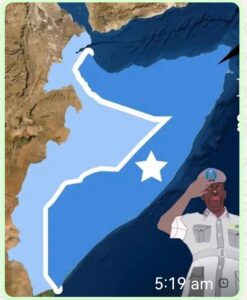
The Mirage of Statehood: A Critique of Somaliland’s Exclusionary and Unconstitutional Pursuit:
The quest for sovereign statehood is among the most solemn and consequential endeavors a people can undertake. It is a process that demands not only historical grievance and political will but also unwavering adherence to the principles of justice, inclusivity, and the rule of law. According to a worldview grounded in both divine guidance and human reason, such an endeavor must be built upon a foundation of dignity for all, not the subjugation of some. From this ethical and political vantage point, the decades-long project pursued by the de-facto administration of Somaliland, championed by leaders from the Isaaq community, emerges not as a legitimate liberation movement but as an obscure and egregious undertaking. It is a project flawed by its exclusionary clan-based architecture, its persistent violation of its own constitutional order, and its consequent generation of internal crisis and regional instability, all are undermining the integrity and strategic aims of the Somaliland communities or clans.
The very method of this pursuit reveals its fundamental illegitimacy. From Mohamed Ibrahim Igal’s early overtures to Israel in the 1980s to Muse Bihi’s 2024 Memorandum of Understanding with Ethiopia and Abdirahman Cirro’s contemporary endorsements of the criminal state of Sionist Israel, the strategy has consistently operated in the shadows of secrecy and tribal exclusivity, knowing that the Sionist State leaders of Israel are persued by the ICC & ICJ for the crimes against humanity they committed in Gaza and Palestine. Israel itself, functioing as a Pariah state and in need of recognition, will not offer much to Somaliland, but will take in forfeit enormous political, strategic and geostrategic gains by getting access to the red sea and the Golf of Aden.This approach intentionally sidelines the mosaic of communities residing within the claimed borders as well as the much needed regional and international organisations and allies.The Somali proverb “Waan baahanahay looma bahala cuno”—one does not just take what one desires simply because one desires it—applies with piercing accuracy. The Isaaq political elite’s desire for recognition has led them to claim, put on sale, and attempt to consume territories like the Awdal region, whose legitimate inhabitants- Issa and Gadabuursi- and other non-Isaaq communities have never been equal partners in this sovereignty project. Negotiations for souveregnty and unification were successfully undertaken in the years 1948-1959 and definitively sealed in 1960, with the colonial powers under the supervision of United Nations, the process ending with the proclamation and birth of the independent and douvereign Somali Republic of June-July 1960. To force this cecession vision upon others is not state-building; it is a form of internal domination, contradicting the very principles of self-determination it purports to uphold. A legitimate state is forged by the consent of all its people, not by the unilateral will of one demographic exercising political hegemony.
This foundational exclusion is compounded by a blatant and habitual disregard for the rule of law, even laws of the administration’s own making. The accusation that these leaders “do not respect [their] own constitution and institutions” strikes at the heart of their claim to be a democratic beacon. True sovereignty is not merely a flag and a foreign policy; it is the robust and consistent application of a social contract. When constitutions are ignored, when institutions are weakened to serve executive will, and when political processes are tailored to benefit one community, the project loses its moral and legal credibility. It becomes, by its own actions, a de-facto administration rather than a de-jure state, defined not by law but by the power dynamics of its leading faction. This internal contradiction inevitably breeds the very “identity crisis and political confusion” observers note, as the administration struggles to reconcile its democratic pretensions with its authoritarian, clan-centric realities.
The resulting internal confusion manifests in a desperate and contradictory search for an identity that deliberately distances the project from its Somali roots. The spectacle of leaders drawing symbolic connections to Oromo, or Israeli Jews is not a harmless exercise in diplomatic outreach; it is a political strategy to “down grade own Somaliness.” This performative distancing is only a necessary component of the secessionist narrative, which must sever the profound historical, cultural, and ethnic ties that bind the people of the region to the wider Somali nation. However, this strategy comes at a severe cost. It fosters a disjointed national psyche and signals to the communities within who fiercely identify as Somalis that their heritage is being systematically erased in service of a new, artificial nationalism. The integrity and safety of the Somali identity itself is thus seen as being under attack from within, transforming the Somaliland project into a source of profound cultural and political insecurity.
Finally, this obscure pursuit represents a clear oblivion and present dangers to the security and strategic interests of the Somali people and nation. A stable and peaceful Horn of Africa requires clarity and cooperation, not the unilateral redrawing of maps by fiat. The secretive MOUs and military agreements, such as the Ethiopian deal which trades sea access for potential recognition and the secret agreements with Sionist Israel are not merely bilateral issues. They are provocative acts that undermine the sovereignty of the Somali Somaliness, identity, inflame regional tensions, and invite external powers to exploit internal Somali divisions. The project, therefore, shifts from being an internal Somali dispute to a significant factor in regional instability, jeopardizing the security of all Somali people for the unilateral gain of a few serving foreign interests and hostile strategies.
In conclusion, the Somaliland project, as historically executed by its Isaaq tribal leadership, fails to meet the basic ethical and political standards required for legitimate statehood. It is built on the forced incorporation of unwilling communities, sustained by the violation of its ownm legal frameworks, and characterized by an identity crisis born of its denial of Somaliness. It is, in essence, the embodiment of the warned-against behavior in the proverb: taking not out of collective need or just agreement, but out of singular desire. Until this pursuit transforms into a genuinely inclusive, constitutional, and consensual dialogue that respects the rights, particularities and identities of all inhabitants of the territory and acknowledges its inseparable link to the Somali family, it will remain not a beacon of sovereignty, but an obscure and burdensome source of division and crisis. True honor and dignity, bestowed by both divine guidance and human reason, are found in unity with justice, not in exclusionary secession. Reason and legitimacy dictate a collective defence of the Somaliness vital interests.
,