



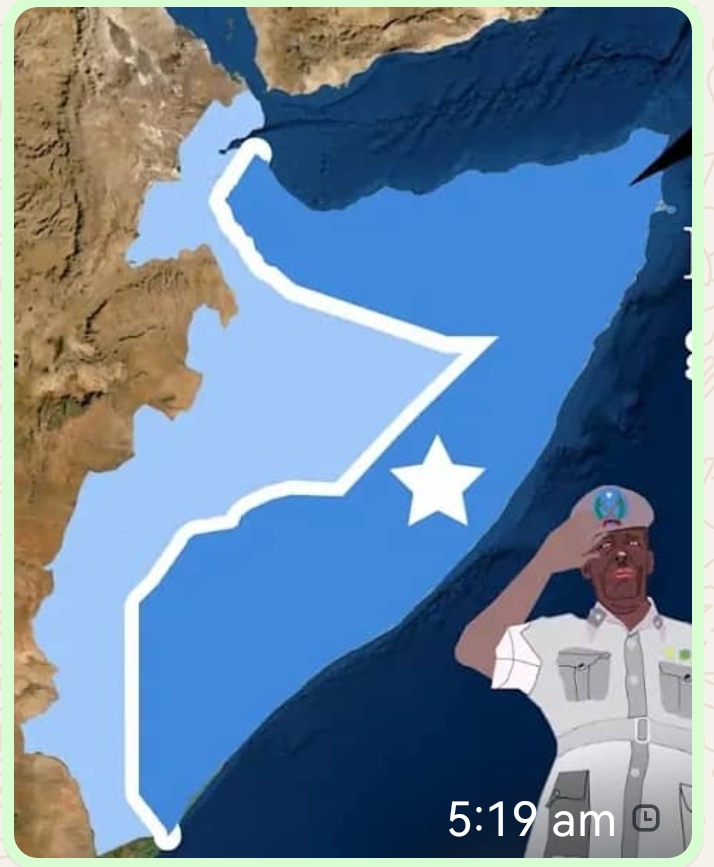
 The Somaliland-Israel Nexus: A Convergence of Pragmatism, Legitimacy Crises, and Geopolitical Realpolitik:
Introduction:
The prospect of diplomatic engagement between the breakaway Republic of Somaliland and the Sionist State of Israel exists at a volatile intersection of humanitarian atrocity, contested sovereignty, and great-power competition. When Somaliland representatives offer evasive answers to journalists regarding normalization—against the backdrop of Israel’s military campaign of known casualties in Gaza—it is not merely a failure of political communication. It is a symptom of a deeper, multi-layered predicament. This scenario illuminates the core tensions within Somaliland’s nation-building project: its struggle for international legitimacy, its internal crises of representation and clan politics, and the profound moral compromises demanded by a realist geopolitics where survival often trumps (overrides) principle. To analyze this dynamic is to dissect how a de facto state, born from post-colonial discontent and civil war, navigates a world order that is simultaneously appalled by and complicit in violence.
I. The Pragmatic Calculus: Recognition as an Existential Imperative:
For Somaliland, unrecognized for over three decades despite relative stability, foreign policy is fundamentally an exercise in securing legitimacy. Engagement with Israel, a powerful pariah-like state with significant influence in Western capitals, particularly the United States, represents a high-risk, high-reward gambit rooted in pure pragmatism.
· The Recognition Quid Pro Quo: Somaliland’s strategy mirrors that of other pariah or partially recognized states (e.g., Taiwan’s relations with certain nations). The unspoken bargain is potential diplomatic recognition or, at minimum, enhanced political and security cooperation in exchange for offering Israel a diplomatic and strategic inroad into a historically hostile region. The recent Ethiopia-Somaliland MoU regarding port access demonstrates Somaliland’s willingness to leverage its strategic geography for political gain; a deal with Israel would be a more audacious iteration of the same logic.
· The “Inadequate Answers” as Strategic Ambiguity: The evasiveness of Somaliland officials is a deliberate tactic under a distant control. A clear affirmation would trigger immediate and possibly devastating backlash from the domestic public, the Somali Federal Government (FGS), the Arab League, and the Organization of Islamic Cooperation (OIC). A clear denial would foreclose a potentially transformative geopolitical card. Thus, ambiguity serves as a holding pattern, allowing exploration of backchannel talks while maintaining plausible deniability.
II. The Moral Abyss: Navigating Identity Amidst Atrocity
The pragmatic calculus crashes against the hard wall of moral and identity politics. Somaliland’s population is uniformly Muslim, and its founding narrative is deeply intertwined with Somali nationalism, even as it seeks to divorce from the Somali state.
· The Weight of Muslim Solidarity: The devastation in Gaza, documented daily, makes any normalization with Israel politically toxic at the grassroots level. For Somaliland’s leadership, this creates a severe legitimacy deficit at home. The Palestinian cause remains a powerful unifying symbol in the Muslim world, and aligning with its primary antagonist can be framed as a betrayal of both faith and a shared post-colonial struggle.
· The “Birds of a Feather” Narrative and Its Power: The argument that “birds of a feather flock together”—linking Somaliland’s secessionist leaders (accused of treason by Mogadishu) with Israeli leaders pursued by the ICC—is a potent rhetorical weapon for the FGS. It frames the conflict not as a dispute over self-determination, but as a moral contest between a lawful, unified Somalia and an outlaw entity making common cause with other alleged violators of international law. This narrative resonates regionally and domestically among those opposed to secession.
III. The Internal Fracture: The Clan Question and the Limits of Representation
The most penetrating critique of Somaliland’s foreign policy maneuvers stems from its unresolved internal contradictions. The claim that Somaliland’s government represents a unified polity across its claimed borders is fundamentally disputed and fake.
· Deconstructing the Clan Demographics: As outlined, Somaliland’s national project is dominated by the sole Isaaq clan, which bore the brunt of Siad Barre’s violence, as narrated, and forms the core pro-independence constituency. However, the claimed territory includes:
1. The Harti/Darod clans (Dhulbahante, Warsangeli): These groups largely inhabit the contentious Sool, Sanaag, and Cayn (SSC) regions. Their political allegiance leans strongly toward Puntland and the Somali Federal Government. The recent reintegration of the SSC region into the FGS administration is a catastrophic blow to Somaliland’s territorial narrative. For these groups, Hargeisa’s policies, including flirtations with Israel, are imposed by an alien authority.
2. The Issa (Dir) clan: Predominant in the far west (old of Zeila-Lughaya districts), their cultural and kinship ties lie with Ethiopia and Djibouti. Their commitment to the Somaliland project is often qualified and pragmatic.
3. The Gadabuursi (Dir) clan: In the Awdal region, their support has historically been variable, with factions also looking toward Ethiopia or a federal Somalia.
· The Implications for Foreign Policy: When critics ask, “Do Somaliland leaders represent all components?” the answer, in practice, is no. A decision as monumental as engaging Israel, taken by a Hargeisa-based government, would likely be seen as an Isaaq-dominated decision, further alienating the non-Isaaq communities already skeptical of or hostile to the secessionist project. It exacerbates the internal legitimacy crisis, making Somaliland appear less like a consensual nation-state and more like a clan project with expansionist claims.
IV. The Geopolitical Chessboard: Agency vs. Pawnhood
The final layer is the accusation that Somaliland is merely a pawn, its media and political class serving “Western interests and geopolitical strategic games.”
· The Charge of Neo-Colonialism: From a critical perspective, Somaliland’s quest plays into a broader pattern of regional fragmentation favored by external powers for easier influence and resource access. Its port at Berbera is already a strategic asset for the UAE. Ties with Israel would align with a U.S.-led security architecture in the Red Sea aimed at containing Iran and monitoring jihadist threats.
· Agency within Constraint: Conversely, Somaliland’s leaders are not mere puppets. They are actively leveraging their geopolitical value to achieve a decades-old nationalist goal. They seek to turn their vulnerability into agency by making themselves indispensable to powerful actors. The “dirty game,” in this view, is not arguably against Somali identity but for Somaliland’s survival in an anarchic international system that offers no peaceful, legal path to recognition.
Conclusion:
The spectacle of Somaliland officials dodging questions on Israel is a microcosm of their existential dilemma. It reveals a leadership trapped between the imperative of pragmatism (using any lever for recognition) and the burden of morality (the Palestinian cause and Muslim solidarity). This tension is amplified by a profound internal legitimacy deficit, where the government’s authority to make such a fateful decision on behalf of all clans within its borders is hotly contested. Ultimately, the Somaliland-Israel question is not merely about foreign policy. It is a stress test for the very idea of Somaliland: Can an entity born from a specific clan’s grievance and sustained by its dominance transform into an inclusive, legitimate nation-state whose international alliances reflect the will of a unified people? The evasive answers suggest that for now, the leadership knows it cannot pass that test, and so chooses silence, hoping the geopolitical rewards will one day outweigh the paralyzing risks. In the high-stakes game of recognition, moral ambiguity is not a bug; it is the only software that can run.