



The Fabricated Voice and the Real Yearning: Borama’s Deepfake and the Politics of Digital Myth in Awda
Introduction
This essay examines the politics of digital myth in Awdal: the circulation of the false claim that Zeila and Awdal belong to the Gadabursi alone and that the Issa never inhabited the region. The claim is contradicted by the historical record—travellers, treaty texts, colonial administrators, and Ethiopian records document Issa presence and authority—but it travels because it is desired, not because it is true. The essay argues that such fabricated narratives are never merely discursive: they classify, dehumanize, and prepare the ground for violence. Villages have burned, civilians have been killed, and the authority claiming to govern the region has stayed silent. After more than thirty-five years of denial and displacement, the Issa’s restraint may no longer hold. It is time for all to open their eyes and ears.
The Power of Propaganda-Deepfake
In the digital public sphere, a claim does not need to be true to be powerful. It needs only to be desired.¹ This is the central lesson of the politics of digital myth now visible in Awdal. In Borama and across the diaspora, TikTokers and online commentators produce content that frames Awdal as an exclusively Gadabursi space, in explicit opposition to the presence and claims of the Issa community. This content does not merely assert cultural distinctiveness; it advances a specific false historical claim: that Zeila and Awdal belong to the Gadabursi alone, and that the Issa never inhabited the region at all. The claim is repeated across short-form videos, comment threads, and diaspora broadcasts seemingly with the confidence of established fact. It is not fact. It is propaganda, and it operates in the same register as the fabricated digital voice: a narrative that succeeds because it tells its audience what it wants to hear.²
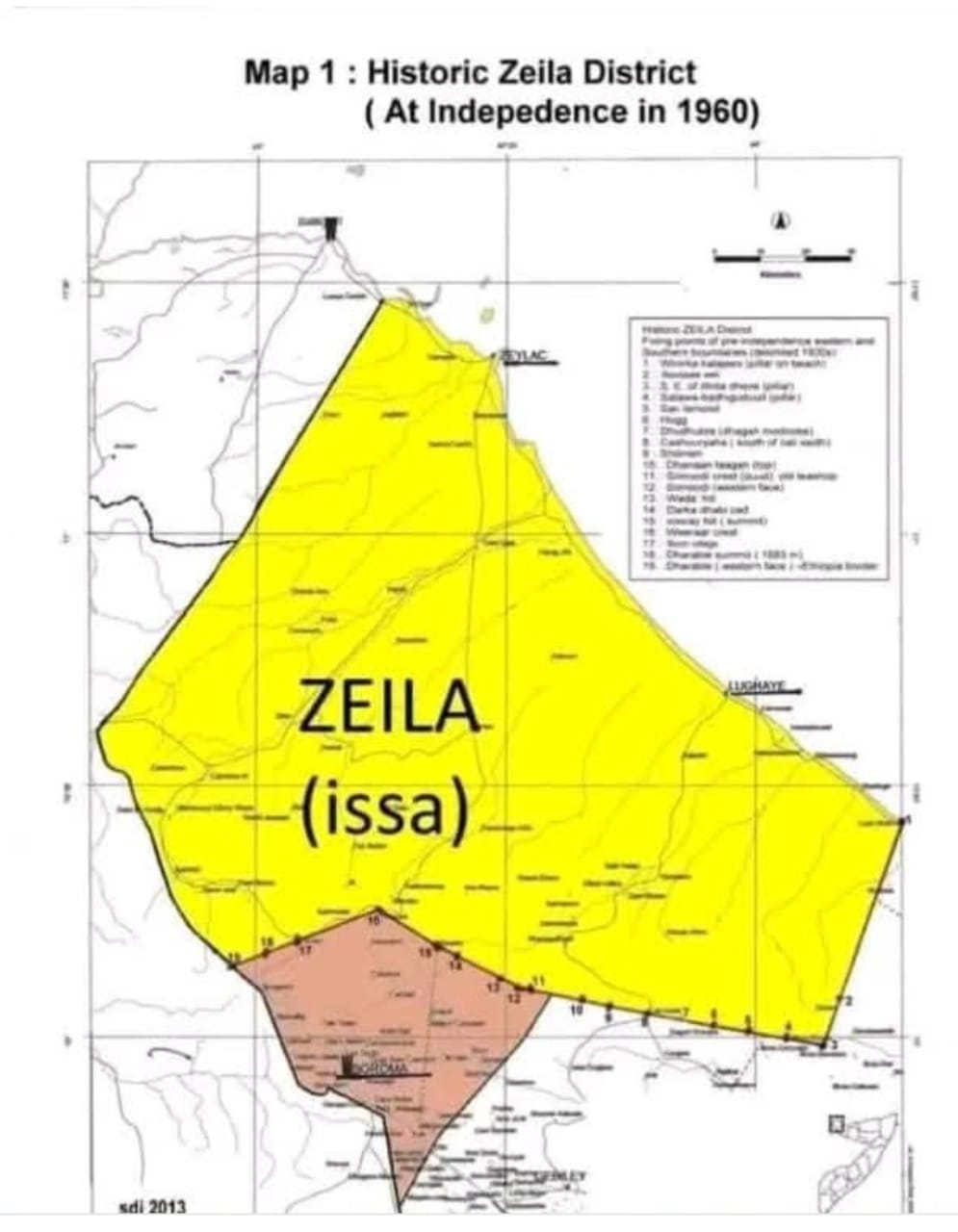
The historical record does not support the claim. Zeila is the birth place of Issa and the founding place of Xeer Issa, the customary legal system that structures Issa social and political life.³ It is the sole site of the intronisation of the Ughaz, the spiritual, ceremonial and political leadership of the Issa community.⁴ These are not marginal details; they are constitutive elements of Issa identity, documented in historical literature and recorded by foreign by oral history and visitors across multiple centuries. To claim that the Issa never inhabited Zeila is not to offer a competing interpretation of ambiguous evidence. It is to erase a documented history and replace it with a narrative that serves ambitious contemporary political purpose.
The evidence is not thin or obscure. Richard Burton’s account of his journey through Zeila to Harar in the 1850s records Issa presence and authority in the town and its hinterland (old Zaila district and describes the caravan road to Harar as passing through Issa country.⁵ Philipp Paulitschke, travelling in the 1880s, recorded Issa settlements, grazing grounds, and authority along the Zeila–Harar route, and described the tolls levied on caravans.⁶ Jules Borelli and Luigi Robecchi-Bricchetti left comparable notes and travelogues on Issa communities, routes, and authorities.⁷ Alfred Bardey, long resident at Harar, described the Issa role in the caravan economy and the guarantees required for passage.⁸ British, French, and Italian explorers and missionaries—including the Capuchin mission reports in “Les Missions Catholiques and the Annales de la Propagation de la Foi”—described Issa communities and authorities around Zeila and the routes inland.⁹ British and French colonial administrators, in correspondence and in treaty texts published in the British and Foreign State Papers and the French “Recueil des traités”, engaged Issa authorities as actors whose cooperation and guarantees mattered for passage and trade, and concluded agreements with them in the 1880s.¹⁰ The Turko-Egyptian expedition and occupation of Zeila and Harar in the 1870s dealt with Issa authorities in the administration of the town and its routes.¹¹ Ethiopian administrators from Menelik II through Haile Selassie corresponded with and negotiated through Issa ughases over caravan passage and taxation in the Zeila–Harar–Shawa corridor.¹² Multiple traveller and administrative accounts note that the licensed abbaans who secured movement along the commercial corridors from Zeila to Harar and Shawa were drawn solely from the Issa, and that passage depended on Issa guarantors.¹³ Caravan tolls and levies collected by Issa ughases are recorded in the notes and books of writers, reporters, and colonial officials.¹⁴These sources do not establish exclusive Issa ownership of the Metropolitan Port-City of Zaila either; they establish documented presence, authority, and coexistence of multicultural or multiethnic merchants, traders and retailers. But they make the claim that the Issa never inhabited Zeila not a competing interpretation of ambiguous evidence, but an erasure of a documented history.¹⁵
That erasure is not merely antiquarian. It is the first move in a sequence whose later moves are physical. Gregory Stanton’s model of the ten stages of genocide is best understood not as a ladder but as a set of nested processes operating simultaneously: classification, symbolization, discrimination, dehumanization, organization, polarization, preparation, persecution, extermination, denial.¹⁶ Stanton himself has regretted the word “stages,” because it suggests a linearity that the evidence does not support; the processes are concurrent, and each continues to operate even as the later ones begin.¹⁷ The model’s deepest claim is that speech is never only speech. Classification, symbolization, discrimination, dehumanization, and polarization are not preliminaries to violence—they are violence in its early, distributed, and deniable forms. They build the permission structure within which killing becomes thinkable, and then ordinary.¹⁸
Seen through that architecture, the Awdal, Borama, narrative is not an argument about history. It is a stage-by-stage construction. The insistence on exclusive ownership classifies. The label of outsider symbolizes. The denial of Issa presence in Zeila discriminates, by denying legitimacy to a community’s political existence. The rhetoric that “Issa blood is halal” dehumanizes—and this is the pivotal stage, the one that removes the moral inhibition against killing, the one that must be named and rejected as incitement rather than tolerated as opinion.¹⁹ The algorithmically amplified ecosystem organizes and polarizes, coordinating a field of enmity without issuing a single order. The “cartography of desire” that expands ownership to Djibouti and Dire Dawa prepares, constructing an imagined geography in which the removal of others becomes conceivable.²⁰ And then, as the record of the past years shows, the sequence passes into persecution and into killing.
For this is not a new story. The intention to destroy the Issa as a community in and around Zeila and to displace them from their own land has been standing for more than thirty-five years.²¹ It has expressed itself across that period in the systematic denial of rights, in the withholding of representation and services, in the routine dehumanization of the community in official and unofficial discourse, and now in open, armed attacks. What has changed is not the intention but its visibility. The deniable stage has given way to the undeniable one. Villages have been burned. Civilians have been killed in cold blood. Women have been raped.²² These are not the excesses of a moment; they are the operationalization of a permission structure that was built in public, over decades, and left undisturbed.
And here the question of responsibility becomes unavoidable, because the so-called administration that claims authority over the region has never once reprimanded the perpetrators of flagrant hate incitement. It has never spoken the plain truth of what is happening. It has not condemned the rhetoric that declares Issa blood and property lawful to shed and appropriate. It has not named the burned villages. It has not answered the killings. It has not pursued the rapists. Silence of this kind is not neutrality. In the grammar of the ten stages, silence at the stage of persecution is consent; silence at the stage of preparation is encouragement.²³ Where an authority declines to punish incitement, it licenses it. Where it declines to protect a targeted community, it signals that the community is outside protection. And where armed assailants act without consequence, the absence of consequence is itself a form of arming. The administration’s non-reprimand is not a failure of communication. It is a policy, and it must be described as one.
This is not an argument that all digital content from Borama is propaganda, nor that the desire for cultural recognition is illegitimate. The Awdal Development Fund’s documentary work, for instance, is a genuine attempt to preserve heritage that has been neglected. But the ecosystem in which such content circulates does not distinguish carefully between documentation and assertion. The same platforms that host heritage videos also host content designed to claim, to exclude, and to inflate. The algorithm does not care about the difference. It rewards the content that generates the strongest emotional response, and the strongest emotional response is often generated by the story that is least constrained by truth.²⁴
The stakes, therefore, are not discursive. In spite of the fact that this rhetoric does not change an iota of the facts on the ground, it does not lack implications. It widens social gaps. It destroys communal relations. It adds weight to the rhetoric that Issa blood is halal. It nurtures hate and drives away reconciliation and peace. The maps do not move, but hearts harden. The documented history does not change, but neighbours are estranged. The law does not vanish, but trust erodes. A dehumanizing claim is never merely a claim; it creates a permission structure for violence and makes the ordinary work of coexistence harder—and when the violence arrives, the claim is found to have been its advance guard.²⁵
It is time for all to open their eyes and their ears. The self-restraint demonstrated by the Issa over decades—restraint under provocation, restraint under denial, restraint under attack—may no longer work. Restraint is not infinite, and it should never be mistaken for absence of grievance, absence of memory, or absence of capacity. A community that has watched its history erased, its rights withheld, its villages burned, its people killed, and its women violated, while the authority that claims to govern it says nothing, is being told that the language of patience has no addressee. That is the most dangerous condition of all: not the anger of the aggrieved, but the discovery that grievance has nowhere to go. All must be alerted, and alerted now—before the exhaustion of restraint becomes the story that everyone later claims to have seen coming and no one tried to prevent.²⁶
The broader lesson is sobering: in the digital public sphere, the fabricated voice can be more powerful than the real one. It travels faster, says more, and reaches further, because it is unconstrained by the messy realities of history and the legitimate claims of others.²⁷ For those invested in the actual, difficult work of peaceful coexistence in the Awdal region—work that requires acknowledging the legitimate presence and documented history of all communities, including the Issa, and that requires resisting the seductive simplicity of exclusive ownership claims—the challenge is not simply to fact-check. The challenge is to understand why the fabricated story is so appealing, to name the harm it does, and to build spaces where the harder, truer, more complicated story can be heard. But understanding is not enough. The incitement must be condemned by name, the killings must be investigated, the perpetrators must be held to account, and the authority that has stayed silent must be asked, publicly and repeatedly, why it has stayed silent. The voice may be fabricated, but the yearning it taps into is real. The work of coexistence begins with refusing to let that yearning be satisfied by fiction—and with refusing to let fabricated narratives widen the gaps, destroy communal relations, nurture hate, and drive away reconciliation and peace. The time for silence is over. Those who can speak must speak, and those who can hear must listen, before the only voice left is the one that no one wanted to hear.
—
Notes
1. Soroush Vosoughi, Deb Roy, and Sinan Aral, “The Spread of True and False News Online,” Science 359, no. 6380 (2018): 1146–51; Bobby Chesney and Danielle Citron, “Deep Fakes: A Looming Challenge for Privacy, Democracy, and National Security,” California Law Review 107 (2019): 1753–1820.
2. W. Lance Bennett and Alexandra Segerberg, The Logic of Connective Action (Cambridge: Cambridge University Press, 2013); Zizi Papacharissi, Affective Publics (Oxford: Oxford University Press, 2015).
3. On Somali customary law, see I. M. Lewis, A Pastoral Democracy (London: Oxford University Press, 1961); on Xeer Issa specifically, the primary evidence is Issa oral tradition and community historiography, which should be cited as such.
4. On the institution of the Ughaz, see the nineteenth-century travellers cited below and the ethnographic literature on northern Somali leadership institutions; the claim that Zeila is the sole site of intronisation rests on Issa tradition and should be presented accordingly.
5. Richard F. Burton, First Footsteps in East Africa; or, An Exploration of Harar (London: Longman, Brown, Green, and Longmans, 1856), chs. 1–3.
6. Philipp Paulitschke, Harar: Forschungsreise nach den Somal- und Galla-Ländern Ost-Afrikas (Leipzig: F. A. Brockhaus, 1888); Ethnographie Nordost-Afrikas, 2 vols. (Berlin: Dietrich Reimer, 1893–96).
7. Jules Borelli, Éthiopie méridionale (Paris: Librairies-Imprimeries Réunies, 1890); Luigi Robecchi-Bricchetti, Somalia e Benadir (Milan: Aliprandi, 1899).
8. Alfred Bardey, “Notes sur le Harar,” Bulletin de géographie historique et descriptive (1897); see also Arthur Rimbaud, Correspondance, ed. Jean Voellmy (Paris: Gallimard, 1965).
9. Les Missions Catholiques (Lyon, 1868–); Annales de la Propagation de la Foi (Lyon, 1822–). Precise volumes and pages to be verified against originals.
10. British and Foreign State Papers (London: HMSO), relevant volumes for the 1880s Somali coast agreements; French Recueil des traités, conventions, actes et déclarations (Journal Officiel de la République Française). Exact treaty titles, dates, and signatories to be confirmed against the published texts. See Henri Brunschwig, Le partage de l’Afrique noire (Paris: Flammarion, 1971).
11. M. W. Daly, ed., The Cambridge History of Egypt, vol. 2 (Cambridge: Cambridge University Press, 1998); Mohamed Haji Mukhtar, Historical Dictionary of Somalia, new ed. (Lanham, MD: Scarecrow Press, 2003), s.v. “Zeila,” “Harar,” “Egyptian occupation.”
12. Guebre Selassie, Chronique du règne de Ménélik II, ed. Maurice de Coppet, 2 vols. (Paris: Librairie Orientale et Américaine, 1930–32); Harold G. Marcus, The Life and Times of Menelik II (Oxford: Clarendon Press, 1975); Bahru Zewde, A History of Modern Ethiopia, 1855–1991, 2nd ed. (Oxford: James Currey, 2001).
13. On the abbaan system and the Issa role as licensed guarantors on the Zeila–Harar–Shawa routes, see Burton, First Footsteps, ch. 2; Paulitschke, Harar; Mordechai Abir, Ethiopia and the Red Sea (London: Frank Cass, 1980). The claim that licensed abbaan were “solely” Issa should be stated with the qualifications the sources themselves imply.
14. Paulitschke, Harar; Borelli, Éthiopie méridionale; Arthur Donaldson Smith, Through Unknown African Countries (London: Edward Arnold, 1897).
15. Mukhtar, Historical Dictionary of Somalia; Siegbert Uhlig, ed., Encyclopaedia Aethiopica, 5 vols. (Wiesbaden: Harrassowitz, 2003–2014).
16. Gregory H. Stanton, “The Ten Stages of Genocide,” Genocide Watch (1996, rev. ed.); Stanton, “What is Genocide?” (2009), on the “stages” formulation and its revisions.
17. Stanton’s own retrospective remarks on the “stages” terminology and the matryoshka-doll metaphor; see also the critical literature on the model’s linearity, e.g., the discussion in the Journal of Genocide Research on stage models and their limits.
18. On dehumanization as a permission structure, see the literature on incitement and mass atrocity, including the ICTR jurisprudence in Prosecutor v. Nahimana et al., ICTR-99-52 (2003); Susan Benesch, “Dangerous Speech: A Practical Guide,” Dangerous Speech Project (2012, rev. ed.).
19. On “blood is halal” rhetoric as a genocidal speech act, see Benesch, “Dangerous Speech”; Stanton, “Ten Stages,” stage 4.
20. On imagined geographies, see Edward W. Said, Orientalism (New York: Pantheon, 1978); Benedict Anderson, Imagined Communities, rev. ed. (London: Verso, 2006).
21. [Documentation required] The claim of a thirty-five-year continuum of denial, displacement, and periodic violence requires a dated incident chronology and citation to human-rights reporting and witness testimony. This is the essay’s most consequential empirical claim and must not rest on assertion alone.
22. [Documentation required] Specific burned villages, killings, and rapes must be cited individually — named location, date, source (human-rights report, witness testimony, contemporaneous reporting) — in an appendix. General reference should be made to the relevant human-rights monitoring archives and to survivor testimony collected with informed consent.
23. On silence and complicity, see the literature on bystander states and the responsibility to protect; on the duty to punish incitement, the ICTR jurisprudence cited in n. 18.
24. Vosoughi, Roy, and Aral, “The Spread of True and False News Online”; Tarleton Gillespie, Custodians of the Internet (New Haven: Yale University Press, 2018).
25. On the relational costs of hate speech in divided societies, see Benesch, “Dangerous Speech”; and the comparative literature on reconciliation and transitional justice.
26. [Documentation required] On the exhaustion of restraint and the risk of escalation, the essay should cite the conflict-warning literature and, where available, documented statements by Issa elders and community representatives. The sentence is a warning, not a prediction, and should be framed as such.
27. Chesney and Citron, “Deep Fakes”; Vosoughi, Roy, and Aral, “The Spread of True and False News Online.”