



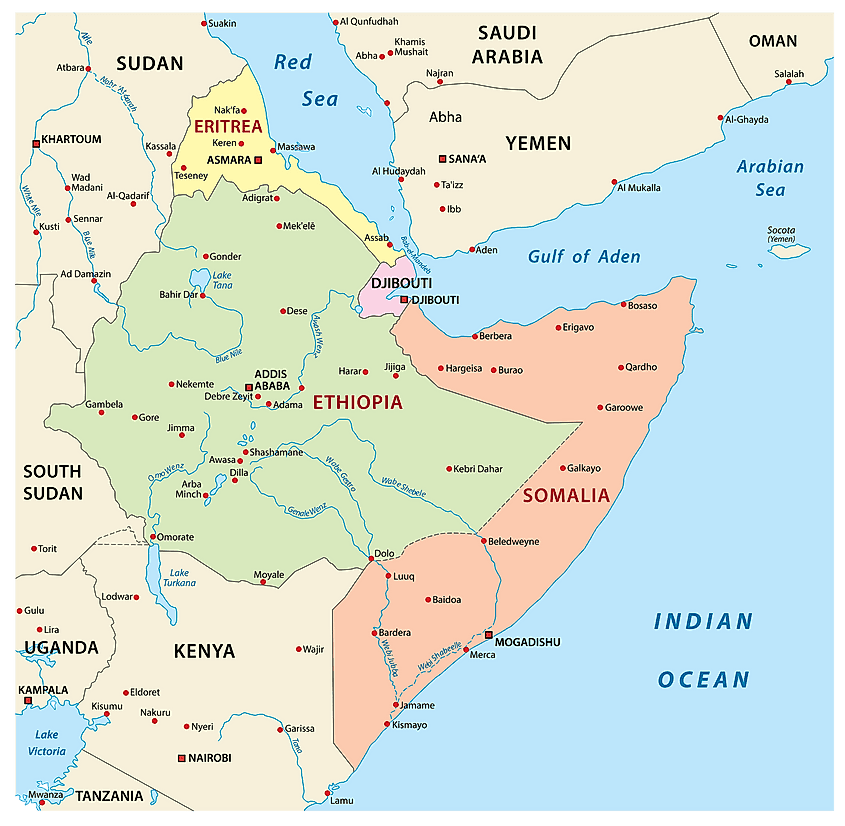
The Secret Game in the Horn of Africa: A Geostrategic Tapestry:
The Horn of Africa, a region steeped in history and complexity, has recently become a focal point of international intrigue and strategic maneuvering. With its proximity to vital maritime routes, the region has attracted the attention of global powers eager to secure their interests. At the center of this unfolding drama is Ethiopia, under the leadership of Prime Minister Abiy Ahmed, whose ambitions to access the sea and establish a naval base have ignited a series of geopolitical chess moves involving the United States, Russia, France, Great Britain, and the United Arab Emirates (UAE). The dynamics at play are not merely the result of local aspirations; they reflect a broader, multifaceted struggle for influence in a region marked by shifting alliances and historical grievances.
Ethiopia’s Maritime Aspirations:
Ethiopia, a landlocked nation since the Eritrean-Ethiopian War of the late 1990s, has long sought an outlet to the sea. Abiy Ahmed’s administration has approached this goal with a mix of confidence and secrecy, hinting at a strategic location along the Gulf of Aden or the Red Sea without revealing specifics. This ambiguity raises questions about Ethiopia’s intentions and the potential ramifications for neighboring countries, particularly Somalia, Eritrea and Djibouti.
The ambition for a naval base is not just about access to maritime trade routes; it reflects a desire for regional power and autonomy. Ethiopia’s historical context—a nation that has resisted colonization and maintained a unique cultural identity—fuels its determination to secure a foothold in the maritime domain. However, this ambition cannot be viewed in isolation; it is intertwined with the interests of external powers that see the Horn of Africa as a critical geopolitical chessboard.
The Role of Global Powers:
The involvement of global powers in the Horn of Africa is a testament to the region’s strategic importance. The United States, Russia, France, and Great Britain have all shown a keen interest in shaping the geopolitical landscape. High-ranking Western officials and Russia have been spotted either taking interest in the Ethiopian Naval set up or lobbying for the recognition of Somaliland as a sovereign state, a move that would alter the balance of power in the region. Somaliland, a self-declared republic, has long sought international recognition, U.S. and E.U. support could embolden its aspirations while simultaneously complicating relations with coastal states.
Meanwhile, the UAE’s investments in Ethiopia’s future Naval Base and commercial Port signal a commitment to fostering a strong ally in the region. The UAE’s involvement is not merely philanthropic; it is a calculated strategy to enhance its influence in the Horn of Africa. The establishment of a naval base and a seaport, in the Red Sea and the Golf of Aden, for Ethiopia, could serve as a proxy counterbalance to Iranian ambitions in the region, particularly given the ongoing tensions involving Yemen and the broader Middle East.
The intricate dance of diplomacy and military visits to Addis Ababa, to support a naval programme by officials from these powers raises concerns about the violation of international law and norms. The pursuit of strategic interests often overshadows the sovereignty of coastal nations like Somalia and Djibouti, leaving them vulnerable to external manipulation. The potential for a conspiracy aimed at undermining their vital interests looms large, adding an alarming dimension to the unfolding scenario.
The Geostrategic Landscape:
The Horn of Africa is not an isolated theater; it is intricately connected to broader geopolitical shifts in the Middle East. The ongoing conflicts in Yemen, the rivalry between Iran and Israel, and the complex relationships among Arab states all contribute to a volatile environment that influences the actions of external powers. The competition for influence in this region often disregards the principles of international law, as nations prioritize their strategic interests over the rights and sovereignty of smaller states.
Ethiopia’s maneuvers, coupled with the backing of the UAE and the tacit support of Western powers, suggest a concerted effort to reshape the geopolitical landscape. The signing of a Memorandum of Understanding (MoU) by Musa Bihi, the former President of Somaliland, is indicative of this trend. It raises questions about Ethiopia’s role in facilitating Somaliland’s aspirations while simultaneously positioning itself as a regional power broker.
The Implications for Somalia and Djibouti:
The potential consequences of these developments for Somalia, Eritrea and Djibouti cannot be overstated. These nations have historically faced challenges related to territorial integrity and sovereignty. The prospect of Ethiopia gaining a strategic maritime foothold could exacerbate existing tensions and lead to further fragmentation in an already complex regional landscape.
Somalia, in particular, has been grappling with internal strife and external pressures. The recognition of Somaliland as a sovereign state would not only undermine Somalia’s territorial souvereignty
but could also encourage other separatist movements within its borders. The implications for national unity and stability are profound, raising concerns about the potential for conflict and instability in a region already beset by challenges.
Djibouti, strategically located at the entrance to the Red Sea, Babelmandab, has long served as a hub for international military presence. The competition for influence in the Horn of Africa could lead to a recalibration of Djibouti’s relationships with external powers, as it navigates its role in a shifting geopolitical landscape. The potential for increased military presence and strategic partnerships could bring both opportunities and challenges for Djibouti as it seeks to balance its interests with those of larger powers.
Conclusion: A Call for Caution:
The secret game being played in the Horn of Africa is a complex interplay of ambition, power, and geopolitics. As Ethiopia seeks to secure its maritime aspirations, the involvement of global powers and the proxy mission played by UAE adds layers of intrigue and uncertainty. The ramifications for Somalia, Eritrea and Djibouti are significant, raising questions about sovereignty, stability, and the potential for conflict.
In this intricate tapestry of interests, it is crucial for regional actors and the international community to prioritize dialogue, cooperation, and respect for international law. The pursuit of strategic objectives should not come at the expense of the rights and aspirations of smaller nations. As the Horn of Africa navigates this uncertain terrain, a commitment to peaceful resolution and mutual respect will be essential in averting a crisis that could have far-reaching consequences for the region and beyond.
In navigating this complex landscape, the world must remain vigilant, recognizing that the stakes are high and the potential for miscalculation is ever-present. The Horn of Africa is not merely a backdrop for geopolitical maneuvering; it is a region with its own aspirations, challenges, and potential for resilience. The secret game being played should not overshadow the voices of those who call this region home, for their futures are intricately tied to the outcomes of this unfolding drama.