



The Awdal Crisis: A Path to Coexistence or Perpetual Conflict?
Introduction
The tribal crises engulfing the Awdal region of Somaliland represent one of the most serious challenges to peace and stability in the Horn of Africa today. What began as simmering tensions rooted in decades of marginalization has erupted into deadly conflict between communities that once coexisted as brothers. The situation demands urgent attention not merely as a local disturbance but as a fundamental test of whether multi-clan societies can reconcile competing claims to territory, citizenship, and cultural identity within a single political framework. The crisis, triggered by the cancellation of a UNESCO-recognized cultural festival in Sayla, has exposed deep fissures in Somaliland’s social contract and raised existential questions for the Issa community about their place in the nation. This essay examines the historical roots of the conflict, analyzes the current dynamics among the principal actors, and evaluates the prospects for peaceful coexistence based on the conditions that the Issa community may articulate for any meaningful resolution.
Historical Context: Thirty-Five Years of Marginalization
To understand the current crisis, one must first appreciate the historical backdrop against which it unfolds. Since the downfall of the Somali central government in 1991, the Issa community in the Awdal region has endured systematic deprivation of their fundamental rights. For more than three decades, they have been denied political representation, economic prosperity, job opportunity, social services, and even the basic recognition of citizenship within the Somaliland polity. This marginalization was not random or accidental but reflected a calculated political strategy that viewed the Issa as a potential fifth column—a community whose loyalty to the Somaliland project could never be fully trusted, given their cross-border kinship ties with the Issa of Djibouti and Ethiopia.
Throughout this period, peace in the region remained precarious, maintained not through genuine reconciliation but through the patience and hope of the Issa community that reason would ultimately triumph. They believed that with time, their contributions would be acknowledged, their rights restored, and their place in the national fabric secured. This patience was not weakness but a conscious choice to prioritize harmony over confrontation, coexistence over conflict. The Xeer Issa—the customary law that has governed Issa society for generations—embodied this commitment to order and dispute resolution through established mechanisms rather than violence.
The recent UNESCO designation of Xeer Issa as an intangible human heritage represented a moment of profound validation for the Issa community. It signaled international recognition of their cultural contribution to humanity and offered hope that their traditions would be preserved and respected. The planned celebration in Sayla was therefore not merely a festival but a symbolic assertion of cultural existence and continuity.
The Immediate Trigger: The Cancellation in Sayla
When the Somaliland administration cancelled the UNESCO registration celebration in Sayla at the request of Gadabursi claimants who asserted exclusive ownership of the town, the decision struck at the heart of Issa identity and belonging. The cancellation was not perceived as a neutral administrative act but as a fundamental denial of Issa rights to their own cultural heritage on land they considered theirs. The message was unmistakable: the Issa had no standing in Sayla, no right to celebrate their heritage there, and by extension, no legitimate place in the broader Somaliland polity.
What followed was even more alarming. The Borama community launched a coordinated propaganda campaign across all media channels, unleashing a torrent of hostile threats, insults, and incitement that crossed every boundary of civilized discourse. The slogans were chilling in their clarity and intent: “Issa is not a citizen of Somaliland,” “Issa have no right in Somaliland,” and “The Xeer is an oeuvre of an infidel and a satanic tradition.” These were not random expressions of anger but coordinated attacks designed to dishonor and delegitimize an entire community’s existence.
Most terrifying were the calls to violence. The propaganda declared that “the blood of Issa is halal”—a religiously framed license to kill. It proclaimed that any Gadabursi who failed to kill any Issa they encountered, who spared their children, or who did not defile their women should be considered a bastard, not a true Gadabursi. This language of extermination, reminiscent of the darkest episodes of ethnic conflict, transformed political or societal disagreement into genocidal incitement. The Issa community, already marginalized for more than three decades, now faced existential threats from neighbors with whom they had once harmoniously coexisted.
The Actors and Their Interests
The crisis involves three distinct actors whose interactions have produced the current conflagration. Understanding each actor’s position is essential to grasping the dynamics at play and the obstacles to resolution.
The Somaliland Government
The ruling or governing party, Isaaq, of Somaliland occupies the most complex and arguably most responsible position. As the entity claiming sovereign authority over the entire territory, it bears primary responsibility for maintaining peace and protecting all citizens regardless of clan affiliation. Yet the Issa community perceives this party as fundamentally biased, aligned with the Gadabursi in a conspiracy against them. The government’s response to the crisis—silence in the face of incitement, passivity as violence erupted, and a posture limited to unfulfilled promises—has reinforced this perception. By failing to coerce or at least condemn the hate speech, by refusing to affirm Issa citizenship rights, and by neglecting to intervene decisively to stop the violence, the government has effectively communicated that Issa lives and rights are less worthy of protection.
The Gadabursi Element
The second group, the Gadabursi tribal element driving the conspiracy, has been motivated by what the Issa community describes as “an attractive deal”—the prospect of forcibly displacing the Issa and appropriating their land. This is not spontaneous ethnic animosity but calculated political and economic predation. The land in question, particularly in the Sayla and Lughaya areas, represents valuable territory, and the alliance with the ruling party offers a pathway to acquire it through state-sanctioned means. The propaganda campaign serves to manufacture consent for this land grab by dehumanizing the Issa and framing their elimination as a religious and patriotic duty.
The Issa Community
The third group, the Issa community, stands as the victim of this conspiracy. For thirty-five years they have endured deprivation; now they face existential threat. So alienated, their traditional leaders—the Grande and the Ogaas—have been forced to call for self-defense within their own territory, a decision of last resort when all other avenues have been exhausted. The Issa did not seek this conflict; they sought recognition, rights, and coexistence. But when faced with threats of extermination and a government unwilling to protect them, self-defense became not a choice but an imperative.
Immediately, on this declaration, contingents from Gadabursi tribes, both from inside and outside the border, conducted attacks on different fronts, burning houses. Successfully repulsing these attacks, the Issa defensive forces fortified their lines without crossing tribal boundaries. The next move is not certain. All eyes are fixed on the initiative that the Somaliland government may take. From the Issa perspective, peace is always possible—on conditions.
The Issa concept or Conditions for Peaceful Coexistence
Despite the gravity of the situation, the Issa community has not closed the door to peaceful coexistence. Their traditional leaders my articulate a comprehensive framework for resolution, grounded in historical precedent and constitutional continuity. These conditions represent not maximalist demands but a reasoned path back to stability, offered in the hope that reconciliation remains possible. The conditions rest on several interconnected pillars.
First Condition: Return to the Constitutional Status Quo Ante 1960
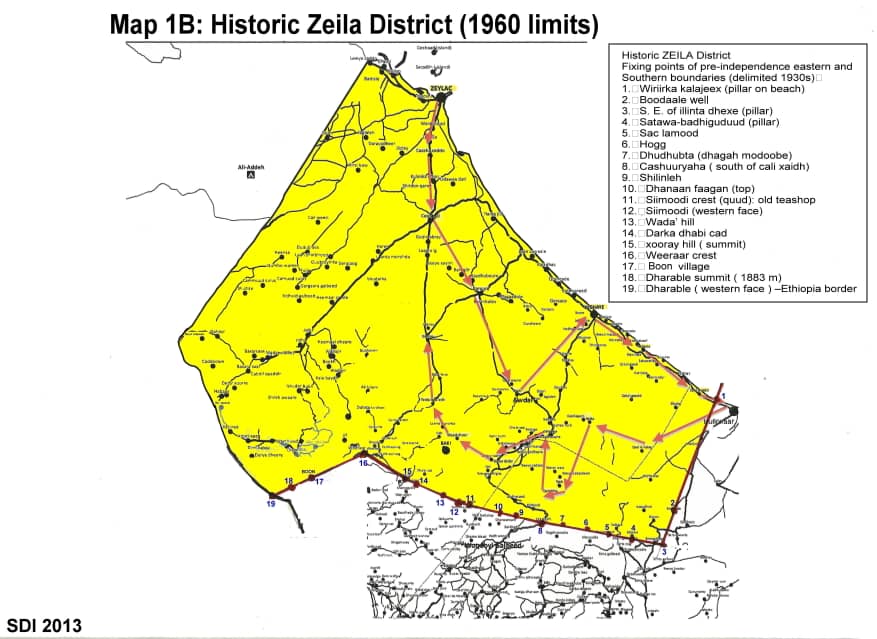
The foundational demand is a return to the constitutional status quo ante 1960. This requires reversing what the Issa community views as the unconstitutional dismemberment of th 1960 Sayla district that occurred during the presidency of Dahir Rayaleh, a Gadabursi. Specifically, the districts of Lughaya and Sayla must be reunited to form the new region to be named SELEL. This is not a demand for secession or the creation of a new entity outside Somaliland but rather a restoration of the administrative configuration that existed at the time of Somaliland’s original independence and union with Somalia. It is a demand for the rule of law, for adherence to the constitutional arrangements that governed the territory before unilateral alterations that disadvantaged the Issa.
Second Condition: Regional Autonomy for SELEL
SELEL must become a polling region autonomous from Borama, in accordance with either the 1960 status quo or the subsequent Somaliland constitution. This autonomy addresses the fundamental grievance of political marginalization. For more than three decades, Issa interests have been subordinated to those of the Borama-based tribal administration, with Issa voices diluted in decision-making processes affecting their own communities. Regional autonomy within SELEL would restore local control over local affairs and ensure that SELEL communities are governed justly with their consent rather than despite it.
Third Condition: Flexible Political Representation
The third condition addresses the complex question of political representation through a nuanced and flexible proposal. If the Mahad Casse sub-clan chooses to remain within the Xeer Issa jurisdiction territory as defined by the map establishing 3×2.5 parliamentary seats for SELEL, those seats would rightfully belong to the region. Alternatively, if historical voting patterns or practical considerations suggest sharing parliamentary representation with Borama, that arrangement is possible provided certain principles are maintained: the Mahad Casse sub-clan would remain citizens of SELEL, but their parliamentary representatives would stand for election in Borama as per the 1954-55 arrangement which they opted for previously. This flexibility demonstrates good faith and a willingness to accommodate practical realities while preserving the essential principle of territorial identity.
Fourth Condition: Recognition of Xeer Issa
The Mahad Casse sub-clan must accept resume adherence to Xeer Issa as before 1991, allowing it to operate as the social framework for harmonious coexistence within the SELEL region. This is not a demand for exclusive jurisdiction but for mutual respect—recognition that SELEL have it’s own traditional governance systems that have maintained order for generations and should continue to do so in matters affecting their communities. Coexistence requires not the suppression of difference but its accommodation within a shared political space.
Fifth Condition: Constitutional Formalization
The fifth condition calls upon the Somaliland government to formalize these arrangements through constitutional mechanisms. The government must apply the constitutional framework establishing SELEL and must explicitly accept and specify the territory governed locally by Xeer Issa. This transforms informal understandings into binding commitments, creating the legal certainty necessary for communities to plan their futures without fear of arbitrary revocation.
Sixth Condition: Comprehensive Guarantees
The sixth condition demands comprehensive guarantees from the Somaliland government regarding SELEL’s regional rights. These encompass autonomy in local governance, equitable development assistance, access to social services, and fair shares in central government positions and resources. These guarantees address the practical realities of regional existence within a national framework—the tangible needs that make autonomy meaningful rather than merely symbolic.
Seventh Condition: Clarifying the Name “Awdal”
Lastly, the name “Awdal” must be brought to the discussion table. Originally, a second name or a nickname of Sayla, the Borama community purposely turned it into a synonym for Borama or Gadabursi, hence creating confusion and conflict. Sayla and Lughaya will remain named “SELEL” as a region; equally, Borama and Baki must choose a name for their region. Awdal must remain a nickname for Sayla.
The Prospects for Implementation
The conditions to be articulated by the Issa community represent a coherent and historically grounded path to resolution. Yet the prospects for their implementation depend on factors largely outside Issa control.
The Somaliland Government’s Choice
The Somaliland government must decide whether it will embrace its role as guarantor of all citizens’ rights or continue its passive posture that effectively endorses the aggression against the Issa. The government’s choice will determine whether peace remains possible or whether conflict becomes permanent. To date, its response has been characterized by inconsistency—approving then cancelling the festival, and most recently announcing peace, a ceasefire agreement on February 14, 2026, only for fighting to resume the very next day. This pattern erodes trust and suggests either incapacity or unwillingness to enforce genuine peace.
The Gadabursi Choice
The Gadabursill actors who initiated this crisis face an equally consequential choice. They can persist in their campaign of displacement and appropriation, pursuing short-term gain at the cost of permanent enmity with their neighbors. Alternatively, they can recognize that coexistence is the only sustainable foundation for regional stability and accept the Issa conditions as the basis for renewed brotherhood. The propaganda of hate they have unleashed will make this choice difficult, as those who incited violence now find themselves prisoners of the passions they aroused.
The Role of Traditional Elders
The suspension of cooperation by Awdal traditional elders with the Somaliland government indicates that trust in Hargeisa’s neutrality is critically low among the Gadabursi as well. The elders accused the minister of making “misleading” statements and violating government norms, undermining the credibility of any state-led mediation. This suggests that any durable resolution must involve genuine Issa-government dialogue followed by inter-clan themselves, with the government playing a neutral facilitating rather than dictating role.
International Responsibility
The international community, having recognized the cultural value of Xeer Issa through UNESCO designation, bears some responsibility for the current crisis. The cancellation of a celebration for internationally recognized heritage should have prompted concern and inquiry. Going forward, international actors can play constructive roles by encouraging dialogue, monitoring human rights, and supporting reconciliation efforts. They cannot impose solutions, but they can create conditions conducive to peace.
The Broader Implications
The Awdal crisis is not an isolated incident but a symptom of deeper structural problems in Somaliland’s governance model. The 1993 Borama Conference, while establishing a clan-based power-sharing arrangement, ultimately concentrated authority in the hands of the Isaaq clan family, leaving non-Isaaq clans like the Issa feeling excluded from the state project. This has created recurring tensions along Somaliland’s peripheries.
Furthermore, recent geopolitical developments have injected new volatility. The recognition of Somaliland by Israel in late December 2025 has been widely condemned and has fueled anti-government sentiment in Awdal, with lawmakers warning of a potential “reconsideration” of the region’s relationship with Somaliland. This external factor could further polarize the clans and complicate internal reconciliation efforts.
Conclusion: The Choice Before Somaliland
The Awdal crisis presents Somaliland with a defining moment. The path chosen now will shape not only the future of the Issa community but the character of Somaliland itself. If the government continues its silence and passivity, it signals that citizenship means nothing, that rights depend on clan power rather than constitutional guarantees, and that might makes right in determining who belongs and who does not. Such a Somaliland would be not a nation but an arena of perpetual conflict, where communities must constantly defend themselves against predatory neighbors and an indifferent state.
Alternatively, the government can embrace the Issa conditions as a framework for resolution and a model for how constitutional order can accommodate diverse communities. By restoring the 1960 administrative boundaries, guaranteeing regional autonomy, respecting traditional governance systems, and providing equal development and representation, Somaliland would demonstrate that its founding ideals of unity and justice remain alive. It would show that even after thirty-five years of marginalization, even after horrific incitement, reconciliation remains possible through principled compromise.
The Issa community has offered a hand of peace, conditional but genuine. The question is whether Somaliland’s other actors have the wisdom and courage to take it. Deadly war has already begun; the government’s response has been inadequate. But the situation is not yet beyond repair. The constitutional framework exists. The historical precedent exists. The will for peace among the Issa exists, tempered by the determination to defend themselves if necessary.
What remains to be seen is whether Somaliland’s leaders will lead toward peace or follow the path of division and destruction. Will they uphold the principle that all citizens, regardless of clan, possess equal rights and dignity? Will they condemn hate speech and incitement to violence with the same vigor that others employ to spread it? Will they honor their own constitution and restore the administrative boundaries that existed at independence?
The answer to these questions will determine whether the Sayla and Borama regions return to brotherhood or descend into perpetual conflict. The Issa have stated their conditions clearly and reasonably. They have not asked for special privileges but for restoration of rights arbitrarily taken. They have not demanded secession but integration on fair terms. They have not rejected coexistence but offered a detailed roadmap for achieving it.
Now the burden shifts to others. The government must choose between justice and complicity. The Gadabursi must choose between predation and partnership. The international community must choose between observation and engagement. And all must recognize that the choice made in Saila-Borama will echo far beyond its borders, shaping the possibilities for multi-clan coexistence throughout the Horn of Africa.
The path to coexistence is clearly marked. The Issa have illuminated it with their conditions. Whether others will walk it remains the great unanswered question of this crisis.