



The Stone and the Gun: An Essay on Geerisa, Resistance, and the Unarmed Defiant
I. Introduction
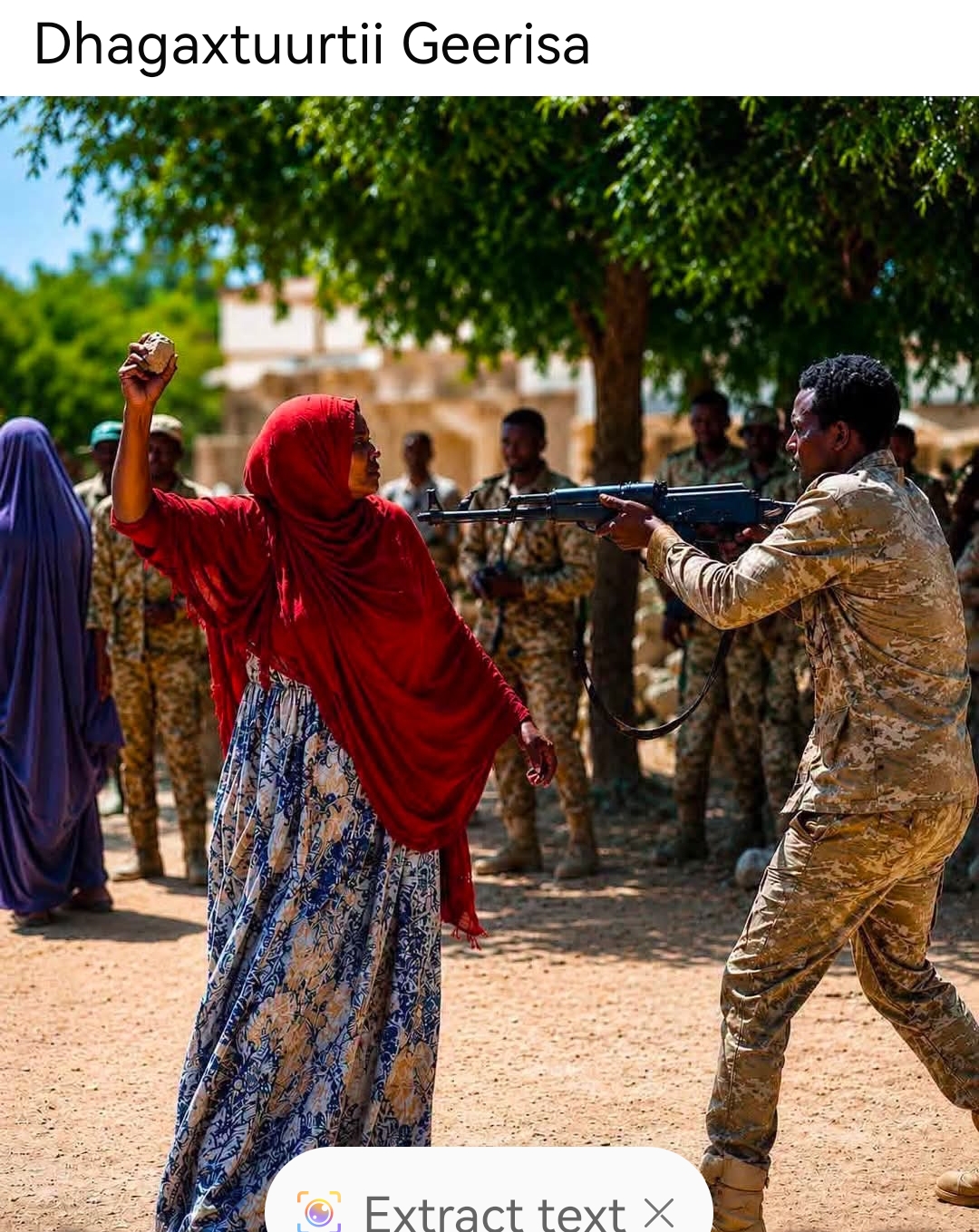
There are images that haunt the conscience of a people. One such image—a woman, barefoot and cloaked in the flowing red folds of the geerisa, standing alone against a uniformed soldier whose rifle towers over her like a metal serpent—has become an indelible portrait of Somali Issa defiance. She holds nothing but a stone. He holds everything the modern state can offer: a helmet, a bulletproof vest, an automatic weapon, the backing of a military hierarchy. Yet the photograph tells a story that upends all expectations. She is calm, almost serene. He is frightened, uncertain, a boy lost in a man’s uniform. Behind her lies Geerisa town—a community of Issa villagers whose only crime was to exist on land claimed by the Somaliland military. This essay weaves together the symbolism of that photograph, the historical philosophy encoded in the geerisa garment, and the brutal reality of state violence against pastoral communities. It argues that true power does not reside in the gun but in the unbreakable conviction that some lines cannot be crossed—and that death, when met with dignity, is the ultimate victory over tyranny.
II. The Photograph as Text
Let us first read the photograph as one reads a poem. The woman stands at the center of the frame. Her geerisa dress—the traditional red wrap—is not merely clothing; it is armor. It drapes over her shoulders and falls to her ankles, the same cloth symplifies that of Dervish warriors wore when they charged British machine-gun nests a century ago. In her right hand, a stone—ordinary, irregular, almost laughable against the soldier’s assault rifle. But her face is the real weapon: composed, almost maternal, as if she is looking at a disobedient child rather than a man empowered to kill her.
The soldier, by contrast, is a study in collapse. His posture is defensive, his rifle pointed not at her but slightly askew. His eyes—if we could see them behind his visor—would betray the question that haunts every occupier: Why does she not run? Why does she not beg? His uniform, meant to project authority, instead projects vulnerability. He has the gun, but she has the moral high ground—and in the long arithmetic of history, moral high ground outlasts every bullet.
This is not a battle. It is a confrontation of worldviews. His worldview says: Might makes right. I have the gun, therefore I command. Her worldview says: This is my land, my home, my ancestors’ graves. Your gun does not erase my existence. The stone in her hand is not a weapon; it is a symbol. It is the oldest tool of human defiance—the same stone that David used against Goliath, the same stone that every colonized people has picked up when the oppressor’s boot came too close. It is heavy with meaning, light with irony.
III. Geerisa Dress: The Cloth That Refuses to Kneel
The choice of Geerisa as the town’s name is no coincidence. In Somali Issa country, geerisa means both the dignity and courge, by extension, the clan who wears the honour defying a British assailant Battalion in 1891 in the same Geerisa vicinity- Hussain vally . But here, it is a woman who demonstrates the same sacrifice—and that inversion is revolutionary. In traditional patriarchal narratives, the warrior is male. But when men are killed, displaced, or imprisoned, women become the last line of defense. The woman in the photograph is not merely defending her home; she is embodying the very spirit of geerisa—courage, resistance, dignity—in a form that the colonial and post-colonial soldier cannot comprehend.
She is also channeling a deeper Somali philosophy: —”slavery was scarier than death.” For her, the soldier’s demand that she leave her land, abandon her community, and submit to a foreign administration (whether Somaliland, Ethiopian, or any other) is a form of gumeysi—slavery, colonialism, domination. She would rather die with a stone in her hand than live with a leash around her neck. And that is precisely what terrifies the soldier. He was trained to fight enemies who are armed like him. He was not trained to fight a woman who looks at him with the quiet certainty of a martyr.
The photograph thus becomes a living illustration of the motto that accompanies the geerisa image: Courage. Resistance. Dignity. Courage is her standing still. Resistance is her refusal to move. Dignity is her expression—neither angry nor fearful, but absolutely present. She is not performing heroism. She is simply being what she has always been: a Somali Issal woman who knows that her worth is not negotiable.
IV. The Historical Context: Somaliland’s Military Campaigns
To understand the photograph, one must understand the geography and politics that frame it. Geerisa town lies in a region contested between the self-declared Republic of Somaliland and communities that identify as Issa, a Somali clan with deep historical ties to the land. In recent years, Somaliland forces have repeatedly clashed with Issa villagers over borders, resources, and political allegiance. The military has been accused of forced evictions, property destruction, and extrajudicial killings—all in the name of “security” and “territorial control.”
For the Issa villagers, however, this is not a border dispute. It is an existential threat. Their ancestors have grazed their camels on these plains for centuries. Their wells hold water that has sustained generations. Their graves hold the bones of elders who fought against colonial powers, Italian and British alike. To be told by a soldier—often a young man from a different clan, armed with a rifle supplied by a foreign patron—that they must leave is not a political inconvenience. It is an erasure of memory, an assault on identity.
The woman with the stone is not an aberration; she is the culmination of this history. She has seen her neighbors’ huts burned. She has heard the gunfire at night. She has buried children killed by stray bullets. And she has decided—as her grandmothers decided before her—that flight is not an option. The geerisa pride she wears is the same pride her great-grandfather wore when he refused to pay tribute to the British and Italian governor. The stone she holds is the same stone her mother picked up when Ethiopian soldiers came to take their livestock. The soldier’s gun is new, but the struggle is ancient.
V. The Psychology of Fear: Why the Soldier Trembles
The most striking element of the photograph is the reversal of expected emotions. The woman is calm; the soldier is afraid. Why? Because fear is not a function of firepower; it is a function of conviction. The soldier knows, deep down, that he is on the wrong side of history. He knows that his uniform is borrowed authority, that his gun is a tool of domination, not defense. He knows that if he shoots this woman, the photograph will circulate around the world, and he will become the face of inhumanity. He knows that her blood will cry out from the ground, and his children’s children will bear the shame.
The woman, by contrast, has nothing to lose. She has already lost everything that can be taken by force. What remains—her dignity, her memory, her connection to the land—cannot be confiscated. She is not afraid of death because death, for her, is not an end; it is a return to the ancestors who also stood their ground. She is not negotiating; she is witnessing. She is saying to the soldier: You may kill me, but you cannot defeat me. You may take my body, but my story will outlive you.
This is the essence of geerisa philosophy. It transforms the victim into the victor, not through violence but through moral clarity. The soldier’s confusion is the confusion of a man who has never asked himself why he is there. He obeys orders. She obeys her conscience. And in that contrast, the photograph becomes a monument, a mirror held up to all of us: Which side would you choose?
VI. The Stone as Metaphor
The stone in the woman’s hand is often ridiculed by those who see only material power. What can a stone do against a bullet? they ask. But the question is naive. The stone is not meant to defeat the gun; it is meant to indict it. It is a reminder that the soldier’s weapon is ultimately useless against the human spirit. A bullet can pierce flesh, but it cannot pierce a people’s will. A stone, thrown or simply held, is a declaration that the oppressed are not passive recipients of violence—they are active participants in their own liberation, even if that liberation comes through martyrdom.
Historically, the stone has been the weapon of the powerless in every corner of the world. Palestinian children throw stones at Israeli tanks. Indian villagers threw stones at British soldiers. African freedom fighters threw stones at apartheid police. The stone is not a military strategy; it is a moral statement. It says: I may not have your technology, but I have my humanity. I may not have your training, but I have my truth. And my truth is heavier than your bullet.
In the context of Geerisa, the stone also connects to the pastoral economy. A Somali woman’s daily life involves stones—for cooking, for building, for securing the edges of her aqal (portable hut). The stone she picks up is not a foreign object; it is part of her world, part of her home. By arming herself with a stone, she is arming herself with the very soil of her homeland. She is becoming one with the land she defends. The soldier, by contrast, is a stranger even to his own rifle. He is alienated from the earth he occupies. She is rooted; he is uprooted. That is why she stands firm and he falters.
VII. The Role of Women in Somali Resistance
The photograph also challenges the marginalization of women in conventional histories of Somali resistance. Too often, the story of anti-colonial struggle is told as a male epic—Sayid Mohamed Abdullah Hassan’s Dervishes, the sultans, the warriors. But women were always present, often in the most dangerous roles. They carried water to fighters, they hid weapons in their garments, they composed poems that shamed cowards and inspired heroes. They also, when the men fell, picked up spears and stones and faced the enemy themselves.
In the Issa community, women have long been the keepers of oral history. They remember the names of every ancestor, every battle, every betrayal. They teach their children the poetry of resistance. When the Somaliland military comes to evict them, it is the women who step forward first—not because the men are absent, but because the women understand that their role is to bear witness. The man with the gun is temporary. The woman with the stone is eternal.
Her calm confidence in the photograph is not a personality quirk; it is a cultural inheritance. She knows that Somali women have faced worse—famine, colonial violence, civil war—and survived. She knows that her grandmother outlived the British, the Italians, her mother outlived the Siad Barre regime, and she will outlive this latest iteration of a breakawy state brutality. The soldier’s fear is the fear of a man who has no such inheritance, no such depth of time. He is a snapshot; she is a mural.
VIII. The Message Carried: A Universal Call
While the photograph is rooted in the specific tragedy of Geerisa town and the Issa community, its message is universal. Every occupied people has its woman with a stone- it’s own Hawa Tak. Every oppressor has its frightened soldier. The image speaks to Palestinians in Gaza, to Kurds in Syria, to Indigenous peoples in the Americas, to anyone who has ever been told that their land does not belong to them, that their identity is irrelevant, that their survival depends on submission.
The message is not one of despair but of hope. The woman with the stone is not defeated; she is defiant. She does not win in the conventional sense—the soldier may ultimately shoot her, arrest her, or drive her away—but she wins in the deeper sense. She forces the soldier to confront his own conscience. She forces the world to witness the injustice. She plants a seed that will grow into a tree of memory, and that tree will bear fruit long after the soldier has retired and the military has withdrawn.
The motto Courage. Resistance. Dignity. is not a slogan for the powerful; it is a survival kit for the powerless. Courage to face the gun. Resistance to refuse the order to leave. Dignity to maintain one’s humanity even when stripped of everything else. These are not abstract virtues; they are practical tools. They are what enabled the woman to stand still when every instinct told her to run. They are what enabled her to hold a stone when the soldier held a rifle. They are what enabled her to look into his eyes without flinching.
IX. The Tragedy and Triumph of Geerisa Town
Geerisa town, in the aftermath of the military assault, may lie in ruins. Homes may be burned, livestock stolen, families scattered. But the image of the woman with the stone will outlast the destruction. It will be shared on phones, printed on posters, recited in poems. It will become part of the Issa community’s oral tradition, passed down to children who were not yet born when the soldier came. It will transform a local tragedy into a global symbol.
This is the paradox of state violence: it aims to erase, but it often immortalizes. The Somaliland military may have thought it was sending a message of dominance. Instead, it created a martyr for dignity. The soldier may have thought he was enforcing order. Instead, he became the face of oppression in a photograph that will be studied by future generations. The woman may have been unarmed, but she disarmed him in the most profound way—by refusing to accept his power as real.
The geerisa pride she wears is not just a garment; it is a flag. It is the flag of a people who have been conquered but never subdued, colonized but never converted, marginalized but never erased. It is the flag of a people who believe, as the Dervishes believed, that death is not the enemy—submission is. And in that belief, they find a strength that no army can match. “Geeridu mar bay nolosha dhaantada”. The are times when life is scarier than death
X. Conclusion: The Stone Will Outlast the Gun
In the end, the photograph of the Issa woman confronting the Somaliland soldier is not a story of defeat. It is a story of moral clarity. She knew what she was fighting for; he did not know what he was fighting against. She had history on her side; he had only orders. She had a stone; he had a gun. And yet, she was the one who stood tall, and he was the one who cowered.
This is the essence of geerisa philosophy, captured in the image that sparked this essay. “Geeridu mar bay nolosha dhaantaa”. At times life is scarier than slavery.
The woman with the stone has made her choice. She has chosen death over displacement, resistance over resignation, dignity over survival at any cost. The soldier, by contrast, has made no choice at all. He is an instrument, not an agent. And that is why he is afraid.
As we reflect on this image, we are called to make our own choice. Will we stand with the stone or the gun? Will we side with courage or coercion? Will we remember that true power lies not in the ability to destroy but in the willingness to endure? The woman in the photograph—whose name is Nim’a Abdi Ahmed, the daughter of Abdi Ford, has already given us her answer. Now it is ours to give.
Courage. Resistance. Dignity.
These are not just words. They are a way of life. And in the hills of Geerisa, on a day that will be remembered, a woman with a stone showed the world what they truly mean. May we never forget. May we never surrender.